Why SPF Compliance Does Not Guarantee the Inbox

Quick Answer
SPF compliance alone does not guarantee inbox placement. Proper SPF, DKIM, and DMARC alignment, sender reputation, complaint control, and provider-specific monitoring help improve email deliverability. Regular inbox placement testing helps identify issues and measure performance accurately.
Why SPF Compliance Does Not Guarantee the Inbox
Executive takeaway
Passing SPF and other authentication checks does not guarantee inbox placement. Published benchmarks measure different senders, providers, and inbox locations, making headline comparisons unreliable. Primary-inbox results cannot be compared directly with figures that include Promotions tabs. Choose benchmarks that match your audience, sending practices, observation period, and measurement method. Maintain reliable authentication and alignment, but also monitor complaints and actual placement by provider. Improving benchmark averages do not prove that compliance alone caused better results.
One Email Ecosystem, Several Very Different Benchmarks
Email benchmarks appear contradictory because they often answer different questions. Validity’s 2026 benchmark report reports 87.2% global inbox placement for the 2025 observation year. The supplied summary describes customer campaign tests at seed addresses across hundreds of mailbox providers.
Unspam’s 2026 report reports 63% primary inbox placement across tests on its platform. That narrower outcome excludes separately classified inbox tabs. The report’s 2026 label should not be mistaken for a verified, full-year observation period.
DigitalApplied’s 2026 industry report provides a third reference: an 89% commercial-program median. Its selected cohort covers programs sending at least 100,000 opt-in messages monthly and excludes catch-all domains. This describes a particular commercial segment, not every sender subject to authentication requirements.
These figures do not establish a measured performance gap between sender populations. They combine different outcomes, samples, periods, and summary statistics. Validity reports an average; DigitalApplied reports a median. Subtracting their headline percentages would not isolate differences in sender performance.
The practical question is therefore: which benchmark fits your sending program? Match the measured outcome, sender population, provider mix, and observation period before interpreting a gap. Publication year alone does not establish when the underlying messages were tested.
Authentication is a separate requirement, not a placement promise. SPF helps receivers determine whether a server may send for a domain. It does not establish where an accepted message lands. Understanding that distinction requires separating delivery acceptance from inbox placement.
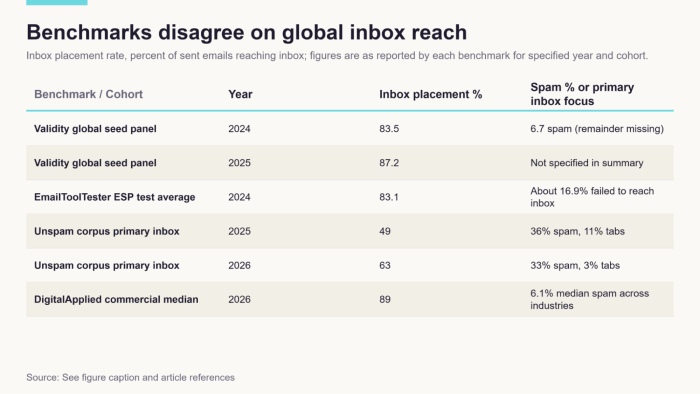
Side‑by‑side view of 2024–2026 headline inbox placement figures from major benchmarks, highlighting how cohort and method drive divergent numbers. Method: Values are taken directly from benchmark summaries: Validity’s global inbox placement for 2024–2025, Unspam’s primary inbox placement for 2025–2026, EmailToolTester’s 2024 ESP test average, and DigitalApplied’s 2026 cross‑industry median for commercial programs.[1][4][11][12]
First Ask What Counts as Reaching the Inbox
“Delivered” does not necessarily mean “in the inbox.” A receiving server may accept a message that subsequently appears in spam. Three measures describe different outcomes:
- Delivery acceptance: the receiving server accepts the message rather than rejecting it; its folder remains unknown.
- Inbox placement: the message reaches an inbox location, including tabs such as Promotions, rather than spam.
- Primary inbox placement: the message reaches the main inbox, excluding separately classified tabs.
An email service provider’s delivery status therefore cannot substitute for a placement test. DigitalApplied’s measurement guidance distinguishes acceptance signals from observations of where messages landed. Promotions is an inbox tab, not spam; treating both as failures conflates inbox sorting with spam filtering.
Seed mailboxes provide direct observations at designated test addresses. Validity’s benchmark tracks tested campaigns across hundreds of mailbox providers and filters, recording inbox, spam, or missing outcomes. These observations describe the test addresses, not every subscriber’s experience.
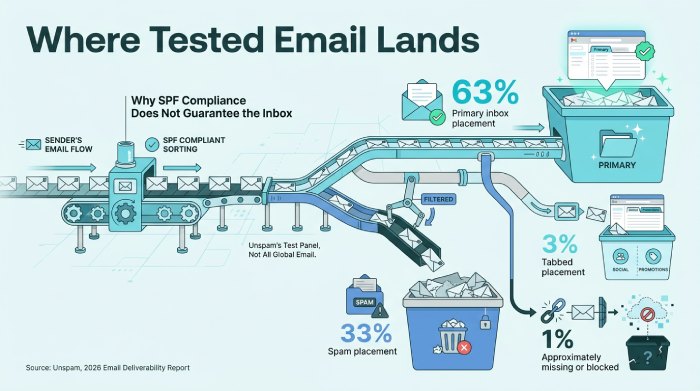
Source: Unspam, 2026 Email Deliverability Report
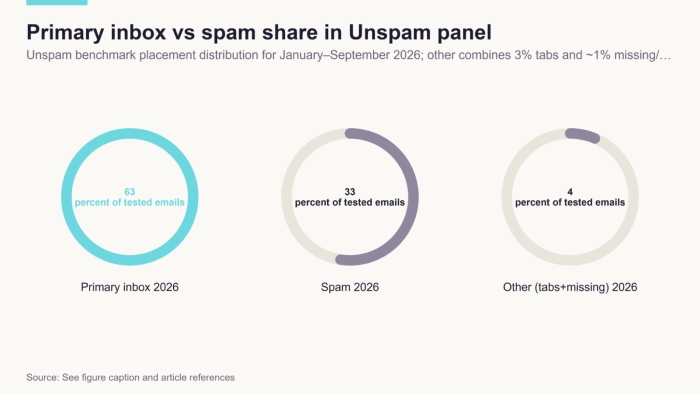
Unspam’s 2026 report aggregates platform tests across eight providers. Its reported distribution is 63% primary inbox, 33% spam, 3% tabs, and approximately 1% missing or blocked. These are tested-message outcomes, not estimates for all email sent worldwide.
Adding Unspam’s rounded primary and tab shares gives approximately 66% total inbox placement within its panel. This calculation changes the headline definition without changing any message’s destination. It does not resolve differences between Unspam’s sample and Validity’s.
Standardized platform comparisons answer another question: how services perform under common test conditions. Shnoco’s secondary summary attributes an 83.1% average across 15 services to EmailToolTester’s January 2024 test. That is a historical comparison, not fresh 2026 performance. Uniform messages, fixed seed lists, and shared sending infrastructure also differ from established commercial campaigns.
DigitalApplied’s industry report instead reports program-level medians for selected North American and Western European senders. Its monthly volume threshold and opt-in requirement restrict the population represented. A median program result is not the proportion of all messages reaching inboxes.
Self-selection further limits interpretation: senders choose whether, when, and what to test. Tests may attract established programs monitoring performance or senders investigating problems. Neither group necessarily represents ordinary email traffic. These designs remain useful, provided comparisons respect their definitions and sampling limits.
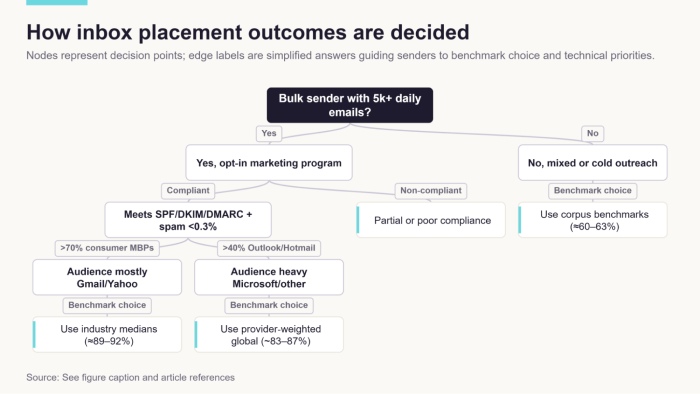
Practical decision guide showing how senders should choose benchmarks and improvement levers based on their provider mix, program maturity, and compliance posture. Method: Tree structure is based on inference from benchmark scopes and policy requirements: nodes walk from sender profile through compliance and measurement choices to the most relevant benchmark target (global average vs industry median) and technical focus (authentication vs behavior).[1][2][8][11][14]Radial visualization of Unspam’s 2026 placement split, emphasizing the large share of mail still landing in spam despite improved primary inbox placement. Method: Percentages are taken from Unspam’s 2026 placement table: 63% primary inbox, 33% spam, 3% tabs, and 1% missing or blocked.[11][35] The radial chart collapses tabs and missing into a small “other” segment to highlight inbox vs spam.
Your Provider Mix Changes the Comparison
Your recipient mix can change aggregate placement even when provider-specific performance stays constant. An overall rate reflects both placement at each provider and the weight assigned to that provider.
For a historical comparison, Validity’s 2024 results, summarized in Warmforge’s review, put Gmail inbox placement at 87.2% and Microsoft at approximately 75.6%. These are reported observations, not current universal rates or predictions for individual senders. The 11.6-percentage-point gap describes the results but does not explain their causes.
A hypothetical mailing illustrates the effect of provider weighting. Assume it reaches only Gmail and Microsoft recipients, with placement fixed at those historical rates:
- 80% Gmail, 20% Microsoft: weighted inbox placement is approximately 84.9%.
- 20% Gmail, 80% Microsoft: weighted inbox placement is approximately 77.9%.
That approximately seven-point difference comes entirely from the recipient mix. These are illustrative calculations, not observed campaign results. In operational reporting, changing provider shares could therefore obscure stable performance within each provider.
Industry medians describe a different dimension: groups of sending programs rather than individual receiving providers. DigitalApplied’s 2026 industry report reports medians ranging from 86% in education to 92% in B2B SaaS. Its cohort includes selected programs sending at least 100,000 opt-in messages monthly. The volume threshold does not establish that every program follows equally strong sending practices.
The 92% SaaS median therefore does not contradict the historical Microsoft result. One summarizes selected programs across their recipient mixes; the other describes placement at a particular provider. Their different years further limit comparison.
Aggregation also matters. The supplied summary describes DigitalApplied’s industry medians as unweighted across programs, regardless of sending volume. The median identifies the middle program result, not the share of all messages reaching inboxes. Provider rates and sector medians describe different populations through different calculations. Their apparent disagreement is not evidence of inconsistent findings.
Authentication Opens the Door but Does Not Decide Placement
Authentication helps establish sender identity; it does not guarantee inbox placement. Nor does it establish whether recipients want a message. Three mechanisms perform distinct functions:
- SPF (Sender Policy Framework) identifies which servers may send email for a domain.
- DKIM (DomainKeys Identified Mail) uses a digital signature to verify signed message content.
- DMARC (Domain-based Message Authentication, Reporting, and Conformance) requires a passing SPF or DKIM identity to align with the visible From domain. It also publishes a policy for handling authentication failures.
A strong SPF configuration is an important part of email security, and tools such as AutoSPF can help organizations monitor and maintain SPF records to support reliable email authentication and deliverability.
SPF evaluation has a 10-DNS-lookup limit for lookup-triggering mechanisms and modifiers. Exceeding that limit can produce a permanent error rather than a pass. The supplied evidence identifies lookup reliability as an operational concern, but does not reproduce the governing technical specification. Its authentication overview provides secondary context rather than independently verified standards text.
An SPF pass does not automatically producee a DMARC pass. The SPF-authenticated domain must also align with the visible From domain. Alternatively, an aligned DKIM signature can satisfy DMARC. Resolving SPF lookup errors therefore addresses one failure mode, not every authentication problem.
Gmail and Yahoo introduced stronger bulk-sender requirements in 2024, including SPF, DKIM, and DMARC. Requirements also covered easy unsubscribing from marketing messages, including one-click support. The sender-policy summary describes authentication becoming a baseline expectation.
Microsoft introduced its high-volume sender authentication rollout in 2025, according to the supplied policy overview. These developments should not be treated as one identical cross-provider rulebook. Provider scope, implementation dates, and unsubscribe obligations require separate checks.
Complaint thresholds likewise need provider-specific interpretation. According to Warmforge’s summary, Google recommends user-reported spam below 0.1% and requires bulk senders to remain below 0.3%. Those figures should not automatically be assigned to Microsoft or other providers.
Figure: Authentication and observed inbox placement
| Observation year | Global inbox placement |
|---|---|
| 2024 | 83.50% |
| 2025 | 87.20% |
| Change | +3.7 percentage points |
Caption: Reported Validity benchmarks show a placement change, not an authentication effect size. The supplied synthesis associates this comparison with the 2026 Benchmark Report. The original tables and methods were unavailable for independent verification.
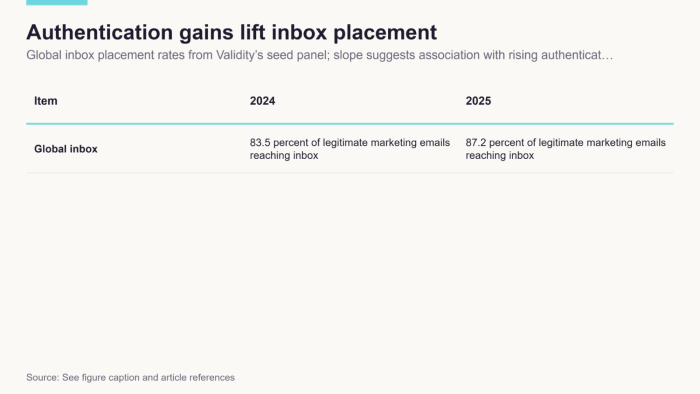
The reported improvement coincided with stronger sender policies, but the comparison does not establish causation. Changes in sender composition, sending practices, or filtering could also contribute. The evidence does not separate these explanations.
Reliable authentication should therefore accompany complaint control, list hygiene, and placement monitoring. Stricter DMARC policies strengthen instructions for handling authentication failures. They should not be presented as automatic inbox-placement upgrades.
Slope chart illustrating how stricter authentication and DMARC enforcement are associated with improved global inbox placement between 2024 and 2025. Method: Inbox placement points use Validity’s global figures (83.5% for 2024, 87.2% for 2025).[5]12] The series labels distinguish years; the upward slope visually links rising adoption of SPF/DKIM/DMARC and complaint control, as documented in Mailgun and DigitalApplied, to the observed uplift, though causation is not directly asserted.[1][3][6][7]
Measure the Failures Your Dashboard Can Miss
A clean delivery dashboard can conceal an inbox placement problem. Acceptance, bounce, and rejection signals do not locate accepted messages. DigitalApplied’s measurement guidance explicitly distinguishes delivery status from placement observations.
The supplied evidence attributes substantial monitoring gaps to Mailgun’s research summarized in its 2025 deliverability takeaways: 70% were not using free reputation-monitoring services, and 53% were not actively monitoring major blocklists. These are reported practices, not measured placement failures. The supplied publication metadata dates the summary to 2026, but does not establish the survey fieldwork period.
The evidence also attributes 87% not using inbox placement testing to Mailgun’s earlier research. However, the supplied report record has inconsistent year indicators, leaving its survey date unresolved. This percentage should not be combined with the other findings as one verified, contemporaneous cohort.
Opens and clicks cannot resolve that measurement gap. A missing interaction cannot distinguish spam filtering from an unread inbox message. An interaction likewise does not establish where every message landed.
A practical monitoring plan should combine signals with different strengths and limits:
- Authentication checks: Test SPF authorization, DKIM signatures, and DMARC alignment. These reveal technical failures, but passing does not prove inbox placement.
- Provider feedback: Review available reputation data and delivery errors. These may identify provider-specific problems without locating every accepted message.
- Complaint trends: Investigate changes by campaign and provider where data permit. Complaints describe reporting recipients, not everyone receiving—or missing—the message.
- Blocklist monitoring: Treat listings as potential reputation warnings. A listing does not establish its effect at every provider; an absence does not establish inbox success.
- Placement tests: Observe inbox-versus-spam outcomes at test mailboxes. As the supplied deliverability guidance distinguishes, placement differs from acceptance. Test-account observations still cannot guarantee subscriber-level outcomes.
When signals deteriorate, review address validity, subscription expectations, and sending frequency. These are diagnostic areas, not remedies with demonstrated percentage gains. Record interventions and subsequent results before attributing improvement to any single change.
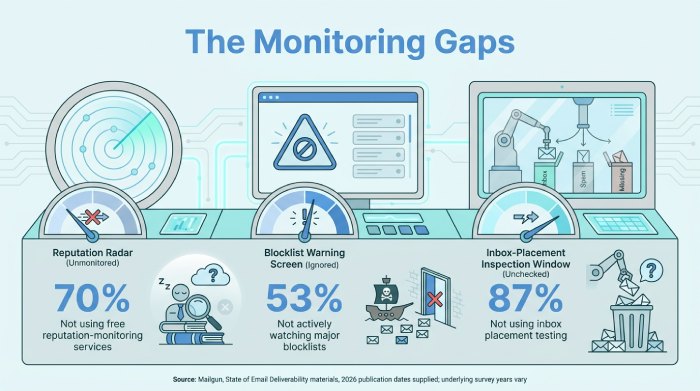
Source: Mailgun, State of Email Deliverability materials, 2026 publication dates supplied; underlying survey years vary
Build a Benchmark That Matches Your Program
Build your benchmark around your program, not the most reassuring headline. The preceding comparisons suggest a practical sequence:
- Define the outcome. Separate delivery acceptance, total inbox placement, primary placement where relevant, spam, and missing mail. Use consistent denominators and category definitions.
- Identify your sender cohort. Record message type, monthly volume, opt-in practices, geography, and program maturity. The DigitalApplied benchmark describes selected commercial programs, not every sender. Matching its volume threshold alone does not make a comparison valid.
- Split results by provider. Track Gmail, Microsoft, and other relevant destinations alongside the overall rate. Keep recipient weights visible so audience changes do not masquerade as placement improvements.
- Choose a comparable reference. Match outcome definitions, populations, observation periods, and aggregation methods. Unspam’s report, for example, separates primary placement from tabs. Its primary-only headline is unsuitable for direct comparison with total inbox placement.
- Track changes consistently. Keep test methods and reporting intervals stable, and document unavoidable changes. Annotate authentication fixes, list cleaning, and campaign changes without assuming each movement reflects one intervention.
Treat industry medians as conditional reference points, not mandatory targets. A matched median can prompt investigation. Exceeding an unmatched average offers little reassurance about your own recipients’ experience.
Investigate authentication and audience signals together rather than closing the case after an SPF pass. Review lookup errors, alignment failures, complaints, and list quality. Complement acceptance logs with inbox placement testing, while retaining its test-account limitations.
These recommendations provide a monitoring framework, not estimated effect sizes for individual interventions. The reported benchmark improvement does not isolate stricter policies’ contribution, and the evidence does not establish product-specific gains.
Reliable authentication and comparable measurement are complementary disciplines. Authentication addresses technical identity requirements. Placement measurement tests whether messages reach inboxes—and prevents a successful SPF check from becoming false reassurance.
Limitations
- The supplied evidence summarizes sources. Full source texts, methods, and underlying datasets were unavailable for independent verification.
- The evidence contains conflicting benchmark definitions and year labels. Unresolved figures are excluded; report labels do not establish complete observation periods.
- Vendor tests and selected commercial cohorts do not represent all email traffic. Seed-mailbox results cannot guarantee individual recipient placement.
- Survey findings describe reported practices, not measured placement. Unclear survey dates and differing cohorts limit comparisons.
- Observed placement improvements do not isolate authentication’s causal contribution or establish product-specific benefits.
References
- Email Deliverability Benchmarks 2026: Industry Report
- Email Deliverability Statistics for 2026: Inbox Placement … - Shnoco
- State of Email Deliverability 2025: Key Takeaways
- Email Authentication and Deliverability: How SPF, DKIM, and DMARC …
- Email Deliverability 2026: Best Practices, Updates & Guide
- State of email deliverability 2025
- 50+ Email Deliverability Statistics in 2026: Benchmarks, …
- 2026 Email Deliverability Report: Benchmark Data vs 2025
- 2026 Email Deliverability Benchmark Report - validity.com
- deliverabilitychecker.com • guides • emailComplete Email Deliverability Guide
- Email Marketing Statistics 2026: Benchmarks and Limits
General Manager
General Manager of DuoCircle. Product strategy and commercial lead for AutoSPF's 2,000+ customer base.
LinkedIn Profile →