What Is an Ice Phishing Attack? A Guide to Protecting Your Emails

Quick Answer
Ice phishing tricks users into approving malicious blockchain transactions or token permissions. Learn how to spot warning signs and protect your email, crypto wallet, digital assets, and sensitive information from these attacks.
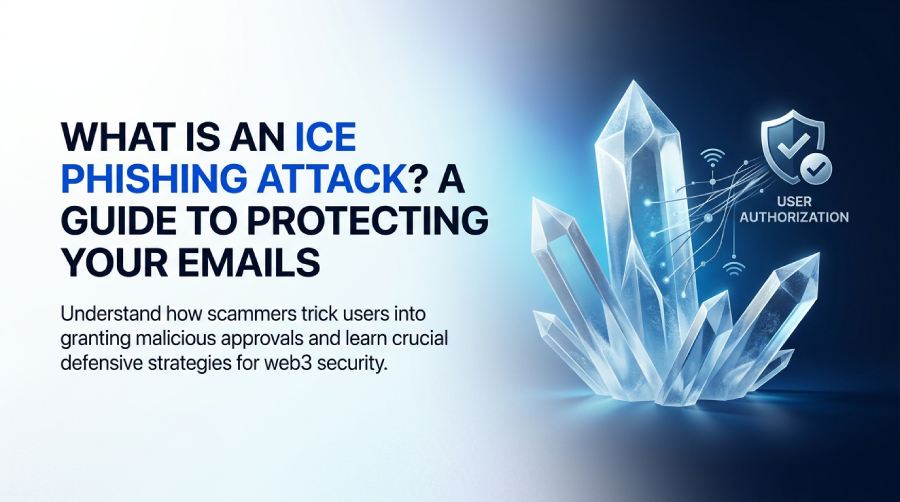
What Ice Phishing Means and How It Differs From Traditional Phishing
Ice phishing is a specialized phishing attack that targets authorization rather than passwords. In traditional credential phishing, an attacker usually tries to steal a username, password, MFA code, API key, or private key by sending a fake login page through email. Ice phishing, by contrast, tricks a user into granting permission—often through an approval transaction or signature request—that lets an attacker move assets later.
The term is widely used in web3 security discussions because these attacks exploit how blockchain applications depend on user authorization. In a web3 environment, a victim may connect a non-custodial wallet to a malicious web interface that resembles a legitimate decentralized exchange, DEX, NFT marketplace, Airdrop claim page, or yield farming dashboard. Rather than requesting a seed phrase, the site may trick the user into approving smart contracts to access or transfer digital tokens.
That distinction matters. A traditional phishing attack may compromise an email Account or a web2 login. An ice phishing scam can compromise token approvals tied to a non-custodial wallet without stealing the private key directly. The attacker may never learn the victim’s cryptographic keys, yet still drain account balances because the user granted authorization to a hostile spender address.
How Ice Phishing Emails Work: Common Tactics, Triggers, and Examples
Ice phishing emails use social engineering to direct recipients from their inbox to fraudulent websites that trick them into approving malicious transactions or sharing sensitive information.
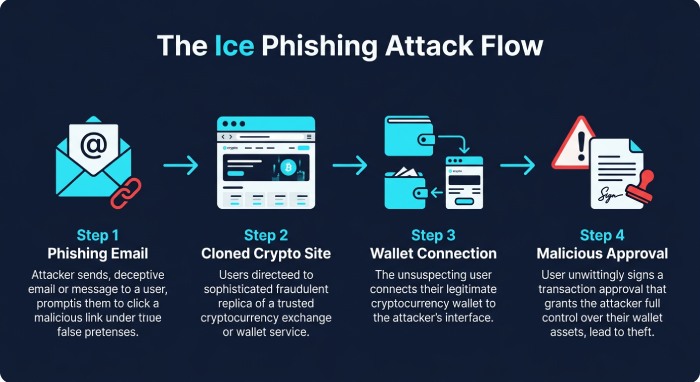
Common email lures used in ice phishing
Attackers often impersonate trusted entities in decentralized finance communities and cryptocurrency services. A message may appear to come from a legitimate digital asset platform or support team. It may reference an urgent token migration, a failed transaction, a reward deadline, or a security check requiring users to reconnect their non-custodial wallet.
Examples include:
- “Your token approval must be renewed.”
- “Claim your cryptocurrency rewards before the deadline.”
- “Your wallet has suspicious activity; verify ownership now.”
- “Your token transfer is pending.”
- “Action required: revoke risky token approvals.”
- “Your wallet approval requires immediate action.”
These messages resemble ordinary security notifications, which is why strong email security controls are essential. Ice phishing thrives when users trust the sender, click quickly, and do not inspect the transaction details.
The web3 flow behind the email
A typical ice phishing attack follows a predictable chain. First, the victim receives an email containing a link to a cloned cryptocurrency website. The page may imitate a legitimate trading platform, digital asset service, or smart contract interface. The site may also use familiar design elements, security claims, or trust badges to appear credible.
Next, the victim connects a non-custodial wallet. The site triggers a signature request or approval transaction. Instead of a normal swap, the user may authorize a smart contract controlled by an attacker. The key detail is often the spender address. If the approval grants broad or unlimited access to tokens, the attacker may later use that authorization to transfer assets from the victim’s wallet.
This is why ice phishing is so dangerous in blockchain ecosystems. The attacker does not need the victim’s cryptographic keys. They abuse authorization. The user’s private key remains inside the wallet, hardware wallet, or browser extension, but transaction signing still creates a valid blockchain instruction.
Warning Signs of an Ice Phishing Attempt in Your Inbox
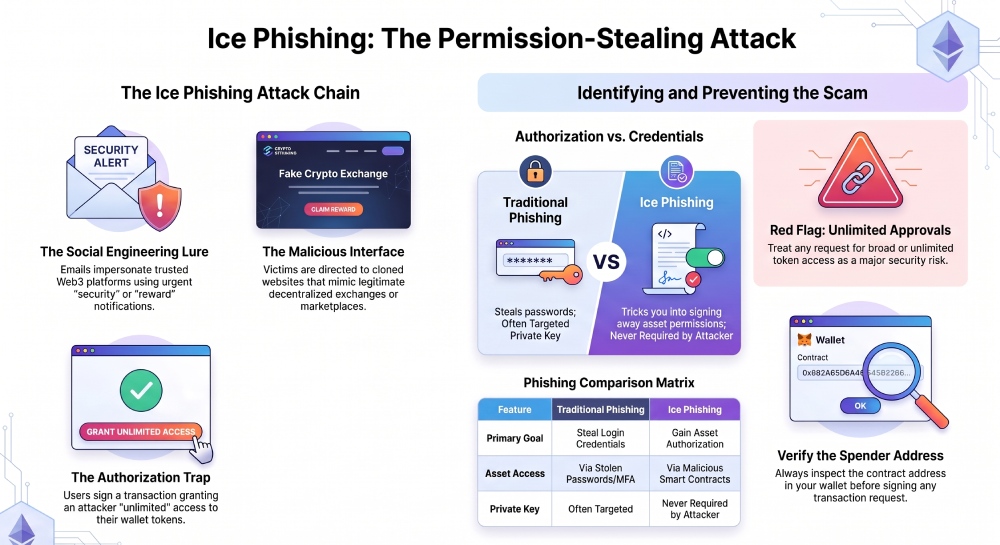 An ice phishing email often looks polished, but several indicators should raise suspicion.
Inbox and transaction red flags
Watch for these warning signs:
- The sender domain slightly differs from the official project domain.
- The email creates urgency around an Airdrop, yield farming reward, total value locked milestone, or urgent token migration.
- A link leads to a site that looks like a decentralized exchange but has an unusual URL.
- The message asks you to connect a non-custodial wallet to “verify” your Account.
- The wallet displays an unknown spender address or unlimited token approvals.
- The signature request does not clearly match your intended action.
- The page asks for cryptographic keys, seed phrases, or a private key—no legitimate cryptocurrency platform should ever require these credentials.
A legitimate blockchain application may require transaction signing, but it should clearly explain which smart contracts are involved, which assets may be affected, and why consent is required. If a cryptocurrency platform requests broad access to your tokens, pause and verify the transaction details and contract information through a trusted source.
Quick example of a risky approval
If you intended to swap a small amount of cryptocurrency but your non-custodial wallet shows an approval transaction granting unlimited token access to an unfamiliar address, treat it as a likely ice phishing attempt. Do not approve the request simply because the page looks like a legitimate trading platform.
Best Practices to Protect Your Email Accounts and Sensitive Data
Protecting against ice phishing requires both email hygiene and blockchain-specific security fundamentals. Because this kind of phishing attack crosses web2 and web3 boundaries, defenses must cover identity, inbox security, wallet behavior, and smart contracts interaction.
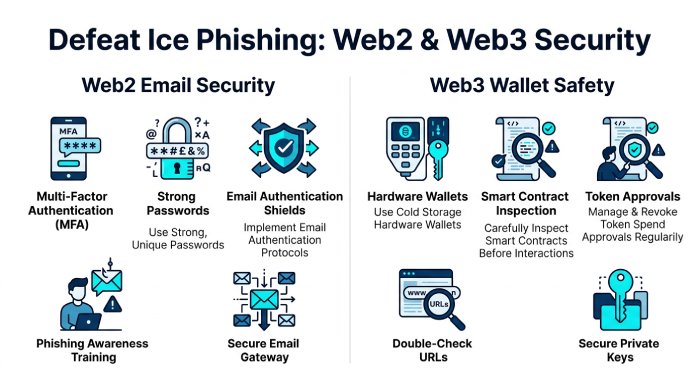 SPF, DKIM, and DMARC strengthen email authentication and can help reduce spoofed or impersonated messages, but they cannot directly prevent the malicious wallet approvals that are central to ice phishing.
Start with your email account. Use strong, unique passwords and phishing-resistant MFA where possible. Be especially cautious of password reset messages, “security alert” emails, and messages tied to cryptocurrency activity. Human-operated ransomware groups and crypto scammers alike use social engineering to create panic and speed.
For web3 safety, separate wallets by purpose. Use a custodial wallet only when you accept the platform’s custody model, and use a non-custodial wallet when you understand that you control the cryptographic keys and transaction signing. Keep long-term holdings in a hardware wallet such as Ledger, and use a separate hot Wallet for DeFi experiments.
Before approving smart contracts, inspect the details:
- Confirm the official domain through multiple sources.
- Avoid unlimited token approvals when a smaller amount is sufficient.
- Review the spender address before signing.
- Treat unexpected signature request prompts as suspicious.
For teams operating a decentralized exchange, DEX protocol, or DeFi application, reduce the attack surface by securing the front-end stack, rotating sensitive credentials, protecting DNS access, reviewing open source code, and conducting an independent security audit. Transaction monitoring, anomaly alerts, and automated threat detection can help reduce response time if a malicious script is introduced.
What to Do If You Clicked a Link or Shared Information
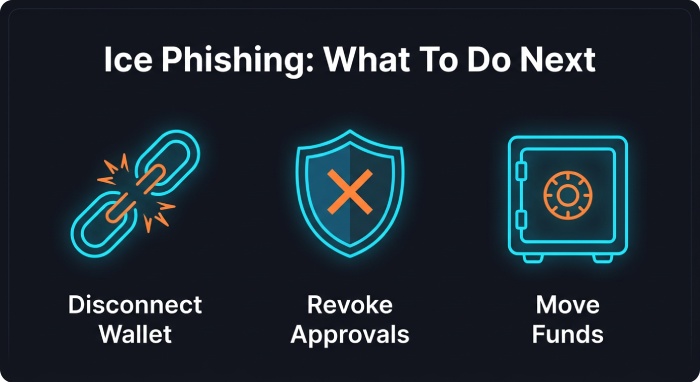 If you clicked an ice phishing link but did not connect a wallet, close the page, do not enter credentials, and scan your device. If you entered an email password, API key, or other sensitive information, change it immediately and revoke active sessions. Treat it like any serious phishing attack or credential phishing incident.
If you connected a non-custodial wallet or approved a transaction, act quickly:
- Disconnect the wallet from the suspicious site.
- Look for unknown approval transaction records and token transfer events.
- Move remaining funds to a clean wallet if you suspect active compromise.
- Preserve transaction hash details for investigation.
- Report the scam to the impersonated project, your security team, and relevant monitoring communities.
Do not assume you are safe simply because your cryptographic keys were not directly exposed. In an ice phishing attack, the attacker may exploit smart contract authorization to gain access to approved assets without obtaining the victim’s private key.
Finally, review how the incident happened. Was the trigger an email spoof, a fake decentralized exchange, a malicious web3 Airdrop, or a compromised web front end? Understanding the root cause helps prevent the next phishing attack and strengthens both blockchain and email defenses.
General Manager
Founder and General Manager of DuoCircle. Product strategy and commercial lead for AutoSPF's 2,000+ customer base.
LinkedIn Profile →