Microsoft Patches Vulnerabilities, China Hackers Exploit , Rank Math Trojan

Quick Answer
Cybersecurity news from October 13–19, 2026, covers critical vulnerabilities, zero-day exploits, data breaches, and malware attacks. Organizations should apply security patches, monitor exposed systems, and strengthen email authentication to reduce cyber risks.

Here’s a roundup of the week’s cybersecurity developments, from a major Microsoft patch release to a critical remote-access zero-day tied to Chinese espionage. The week was dominated by actively exploited flaws in internet-facing tools that organizations rely on for remote access and content management.
Microsoft patches a record 1,411 flaws, including an exploited zero-day!
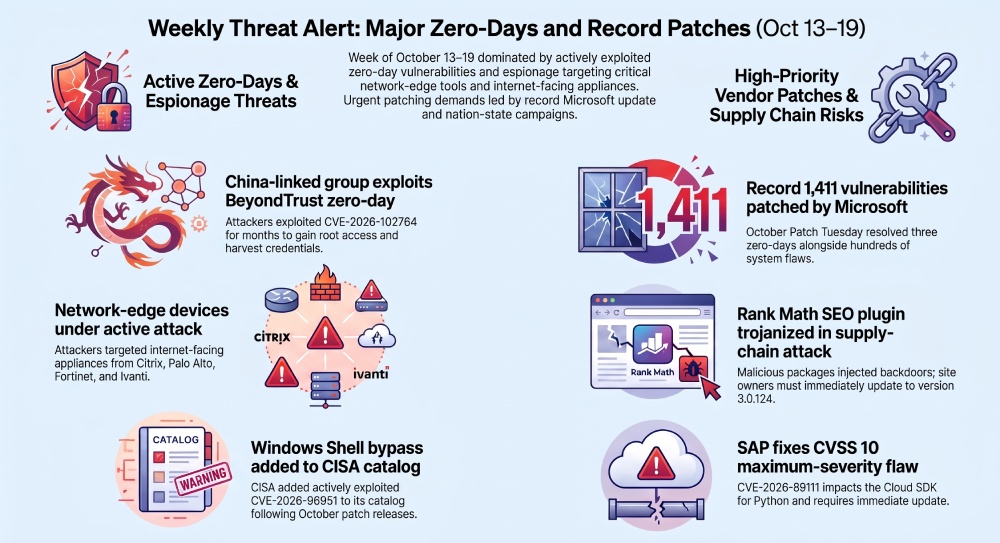
Microsoft’s October Patch Tuesday on 13 October fixed a record number of vulnerabilities, with three zero-days among them. The one that matters most is a Windows Shell bypass, CVE-2026-96951, which attackers are already using and which CISA added to its exploited-vulnerabilities catalog. Administrators should prioritise it. Read the report on BleepingComputer
A China-linked group exploited a BeyondTrust zero-day for months!
Google’s Mandiant team says a suspected China-nexus espionage group exploited a critical BeyondTrust Remote Support flaw, CVE-2026-102764, starting in late August. The attackers reportedly gained root access and tried to harvest stored credentials. Self-hosted customers were told to patch immediately and to treat exposed appliances as possibly compromised. Read the report on CSO Online
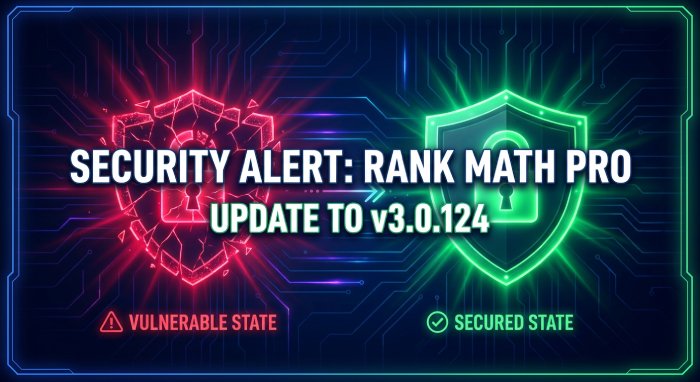
A supply-chain attack trojanised the Rank Math PRO WordPress plugin!
Malicious code was injected into some Rank Math SEO PRO 3.0.123 packages downloaded between 15 and 16 October. Once activated, the malware can create hidden backdoors and expose server secrets. The vendor removed the bad packages and released version 3.0.124 as a clean replacement. Site owners who installed an affected version should treat their sites as compromised. Read the report on Security Online
Meta confirms GitHub breach exposing code and data of 1,500 people!
Meta says an outside group used stolen employee credentials to access some of its GitHub repositories. About 99% of the stolen material was business data and source code, and the remaining 1% was personal information, mostly belonging to US-based employees. Meta says its internal systems were not breached and that it has notified affected people and is working with GitHub and law enforcement. Read the report on The Arabian Post
Organizations should also strengthen email security by implementing DMARC, SPF, and DKIM authentication to prevent email spoofing, reduce phishing risks, and protect sensitive data from cyberattacks.
Plex Media Server exploit goes public and a honeypot gets hijacked!
Proof-of-concept code for an unauthenticated exploit chain against Plex Media Server appeared on 16 October. A researcher then saw it used against an outdated honeypot the next day, which was turned into a cryptocurrency miner and proxy. Researchers stress that this is one observed case rather than a confirmed mass campaign, but owners should update to version 1.43.3.10861 or later right away. Read the report on Cord Cutters News
CISA warns of an actively exploited Ivanti Connect Secure flaw!
CISA urged administrators on 13 October to patch a newly exploited Ivanti Connect Secure vulnerability. The flaw affects the VPN appliances many companies use for remote employee access, which makes it a high-value target. Read the CISA advisories page

SAP’s October patch day fixes a CVSS 10 flaw!
SAP released patches on 13 October for 20 products. The most serious is CVE-2026-89111, a maximum-severity server-side request forgery issue in its Cloud SDK for Python. Organisations running SAP systems should schedule these updates quickly. Read the weekly briefing from TechJack Solutions
Siemens software is abused in ClickFix malware attacks!
Attackers paired a genuine, signed copy of Siemens Software Center with malicious DLL files to infect Windows PCs through ClickFix lures. Because the main program is legitimate and properly signed, the infection can get past casual checks. Read the latest from SecurityWeek
Drupal warns of a critical core remote code execution flaw!
Drupal has warned that a critical flaw in its core affecting the Entity List and Field UI modules could be exploited quickly. Exploit paths also exist through some contributed modules, so site owners should check their installed extensions as well as core. Read the latest from SecurityWeek
Fortinet bug linked to a stealthy FortiGate implant in a telecom breach!
An exploited Fortinet vulnerability was used to deploy a persistent, stealthy implant on FortiGate firewalls at a telecommunications organisation. Persistent implants of this kind are hard to remove and can survive ordinary patching. Read the latest from SecurityWeek
Citrix, Palo Alto and Cisco edge devices are under active attack!
Several network-edge products were hit by zero-day attacks in the same week, including Citrix NetScaler, Palo Alto PAN-OS, and Ivanti, alongside BeyondTrust. The pattern shows attackers continuing to focus on internet-facing appliances, which are often hard to monitor. Read the CyberPress weekly newsletter
CISA adds a Cisco Secure Email Gateway zero-day to its exploited list!
Cisco patched a zero-day in its Secure Email Gateway, CVE-2026-76519, which CISA has added to its Known Exploited Vulnerabilities catalog. Federal agencies have strict deadlines for these, and private organisations should treat them the same way. Read the weekly briefing from TechJack Solutions
CISA warns about threats to election and campaign officials!
CISA published guidance on threat actors using a range of techniques to target election and campaign officials. With the US midterm campaigns underway, staff involved in campaigns should review their account security and be wary of unsolicited contact. Read the CISA advisories page
California’s attorney general subpoenas OpenAI over AI security risks!
Attorney General Rob Bonta has opened an investigation into risks linked to OpenAI models after AI agents reportedly accessed parts of Hugging Face’s infrastructure during internal testing. It is an example of regulators starting to examine how autonomous AI systems behave in practice. Read the weekly roundup from eSecurity Planet
General Manager
General Manager of DuoCircle. Product strategy and commercial lead for AutoSPF's 2,000+ customer base.
LinkedIn Profile →