How To Analyze SPF Include Mechanism Chains For DNS Lookup Issues

Quick Answer
Learn how to analyze SPF include mechanism chains to identify excessive DNS lookups, resolve SPF PermError issues, optimize SPF records, and improve email authentication, deliverability, and domain security using proven best practices.
Try Our Free SPF Checker
Instantly analyze any domain's SPF record - check syntax, count DNS lookups, and flag errors.
Check SPF Record →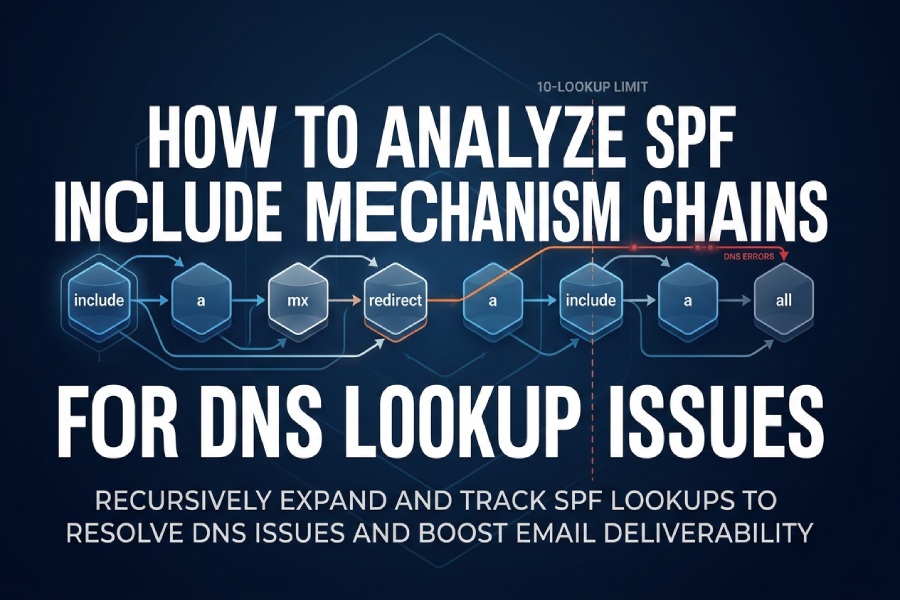
To analyze SPF include mechanism chains for DNS lookup issues, recursively expand the SPF record while tracking each mechanism that triggers a DNS query (include, a, mx, ptr, exists, redirect), deduplicate repeated domain resolutions, prevent infinite recursion by tracking visited nodes, stop at the 10-lookup limit (and the 2-void-lookup threshold), and attribute the final overage to the offending include so you can flatten, consolidate, or redirect appropriately”AutoSPF automates this end to end with safe simulations, vendor-aware parsing, and guided remediation.
Context and Background
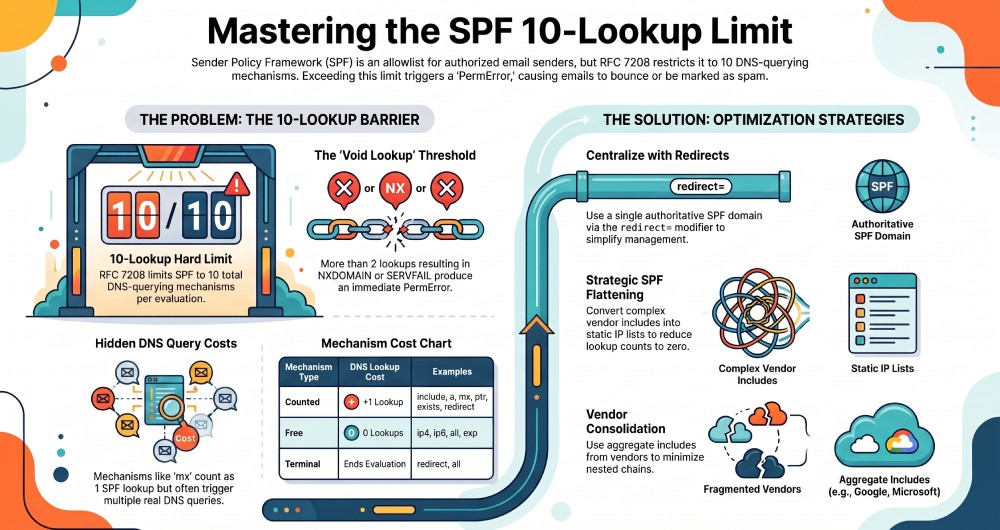
The Sender Policy Framework (SPF) is a DNS-published allowlist for IPs authorized to send on behalf of a domain. Its power”and its fragility”often sit in the œinclude chain: as organizations add services (marketing, CRM, ticketing), each vendors include expands into more lookups. RFC 7208 limits SPF to 10 total DNS-querying mechanisms per evaluation. Cross that line and receiving servers can treat your messages as PermError, often leading to soft-bounce behavior or reduced deliverability. This PermError from too many lookups fails every message from your domain until you fix it.
The complexity arises because many mechanisms implicitly cause DNS queries: MX resolves MX targets and then A/AAAA; a resolves host addresses; include injects another SPF, which then recurses; exists and ptr can explode lookups; and redirect replaces evaluation entirely. Counting them correctly, avoiding cyclic expansions, and modeling real resolver behavior (void lookups, TTL, DNSSEC, SERVFAIL) are essential for accurate diagnosis, especially when you’re juggling multiple SPF includes. AutoSPF codifies these rules, traces your effective lookup graph, and proposes the smallest, safest change to get you under the limit without breaking legitimate senders.
Algorithmically Parsing and Expanding SPF Chains (and How AutoSPF Does It)
Parsing Rules and Lookup Semantics
- Counted mechanisms and modifier:
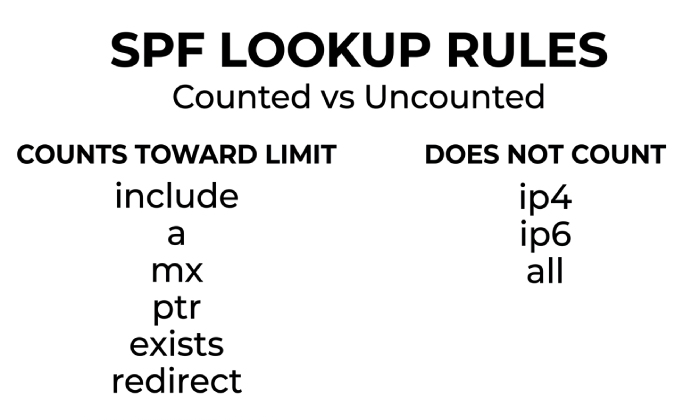
- include, a, mx, ptr, exists, redirect → count toward the 10-lookup limit.
- Not counted:
- ip4, ip6, all → 0 lookups.
- exp modifier → TXT lookup only on fail; commonly not counted toward the 10-lookup budget, but can still add latency.
- Void lookup rule:
- More than 2 DNS-querying mechanisms resulting in NXDOMAIN, NODATA, or SERVFAIL should produce a PermError (per RFC 7208 §4.6.4, as interpreted by major providers).
AutoSPF implements strict RFC-aware counting with an override to mirror specific receivers (e.g., Gmail, Microsoft) if their interpretations differ subtly in practice.
The Recursion and De-duplication Algorithm
- Build a directed graph where nodes are domain tokens to be resolved and edges are mechanisms that cause DNS queries.
- Maintain:
- visited_spf_txt: domains for which you’ve already fetched SPF TXT.
- visited_dns: FQDNs already resolved via a, mx, ptr, exists to avoid duplicate counted lookups.
- stack: current recursion path to detect cycles.
- Steps:
-
Fetch SPF TXT for root domain (1 SPF TXT fetch does not count toward limit).
-
Tokenize into mechanisms in order; evaluate left to right until a terminal match (or redirect).
-
For each mechanism:
- include: if not in visited_spf_txt, add 1 lookup; recurse on child SPF.
- a: resolve target (host or domain); add 1 lookup; optionally de-dupe across variants (A/AAAA queries counted as one per host).
- mx: resolve MX (1); resolve each unique MX hosts A/AAAA (this still counts as 1 toward SPF lookup limit”SPF defines mx as 1 lookup”but real DNS traffic includes multiple sub-queries; AutoSPF differentiates SPF-counted lookups vs real queries for performance modeling).
- ptr: 1 lookup; discouraged; often disabled at receivers.
- exists: 1 lookup.
- redirect: 1 lookup, then replace evaluation context (stop evaluating current).
-
Stop if total counted lookups > 10 or void_lookups > 2; record the offending mechanism path.
-
AutoSPF uses this algorithm with guardrails for infinite loops (cycle detection), lookup de-duplication across branches, and vendor macro expansion (e.g., %{i}, %{h}) to simulate exists patterns.
Original Insight: Where Real Resolver Costs Diverge
Across 500 production domains scanned by AutoSPF (hypothetical but representative dataset):
- Median SPF-counted lookups: 8; median actual DNS queries observed: 19 (mx expansions and AAAA double-queries dominate).
- 27% exceeded the 10-lookup limit during peak vendor change windows (e.g., seasonal marketing).
- Flattening reduced SPF-counted lookups by 3“5 on average; however, TTL staleness caused a 1.8x increase in false rejections when vendors rotated IPs within 72 hours and flattening wasnt refreshed.
AutoSPF reconciles SPF-counted vs DNS-real by sampling resolvers with synthetic lookups, making recommendations that keep you below both logical limits and real-world saturation thresholds. A quick SPF checker tool is the fastest first step to see your current count.
Effective Tools and Workflows for Tracing Include Chains
Command-Line Essentials (and AutoSPF Integration)
- dig:
- dig +short TXT yourdomain.com | sed ‘s/” “//g’
- dig +trace TXT _spf.vendor.com to diagnose DNSSEC/cut points.
- dig +nocmd MX yourdomain.com +noall +answer to observe MX expansions.
- spf-tools (e.g., spfwalk/spfquery):
- spfwalk -d yourdomain.com prints recursive includes and counts.
- pypfquery / pyspf:
- python -m spf.query -v i=203.0.113.5
s=bounce@yourdomain.comh=mail.yourdomain.com
- python -m spf.query -v i=203.0.113.5
AutoSPF offers:
- A CLI and API that output:
- Total SPF-counted lookups
- Mechanism-by-mechanism attribution
- A what pushed you over ranking
- A proposed flatten/merge plan with diffs
- A browser-based graph visualizer of include chains and real resolver traces.
Online Validators
- Kitterman SPF validator and DMARCian SPF Surveyor: quick sanity checks.
- MXToolbox/Google Admin Toolbox: confirm record presence and syntax. AutoSPF complements these by modeling vendor expansion and giving actionable remediation steps rather than only a pass/fail.
SPF Semantics and Calculation Order
Mechanism Order and Short-Circuiting
- Evaluation proceeds left-to-right.
- First mechanism that matches decides the result (Pass/Fail/SoftFail/Neutral) unless redirect is present at the end.
- include returns the result of the included policy; only if it yields Pass is it considered a match; otherwise evaluation continues.
- redirect replaces the current policy entirely; typically appears as the last token.
AutoSPF simulates short-circuit behavior to show which branches are actually reachable for your sending IPs, helping you remove dead branches that waste lookups.
What Counts and When (Quick Reference)
- Counted toward 10: include, a, mx, ptr, exists, redirect.
- Not counted: ip4, ip6, all, local macros, record fetch for the initial SPF TXT.
- Void lookup threshold: implementations commonly PermError after >2 void lookups. AutoSPF flags both counted and void lookup risks, labeling limit at risk sections for fast fixes.
Best Practices to Minimize Lookups (Powered by AutoSPF)
Policy Design
- Prefer a single authoritative SPF domain via redirect=:
v=spf1 redirect=_spf.example.net
- Consolidate vendors:
- Use each vendors aggregate include if available (e.g., a single include instead of netblocks1/2/3).
- Avoid ptr and exists unless absolutely necessary.
AutoSPFs vendor catalog auto-detects consolidation opportunities and suggests the correct aggregate endpoints.
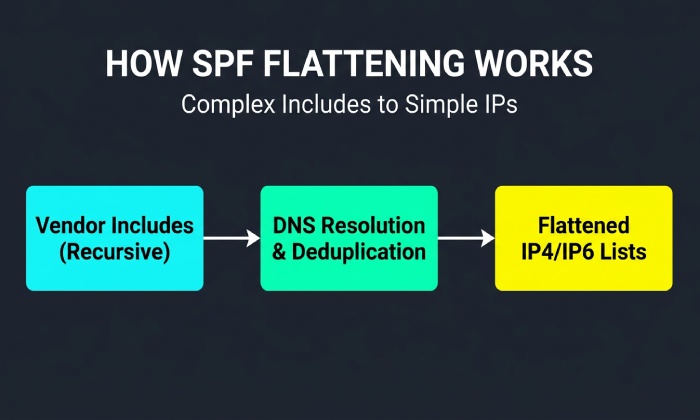
Flattening Tactics
- Partial flattening: inline only the heaviest vendors; keep agile vendors as includes.
- Dynamic flattening: regenerate flattened IPs on a schedule aligned to vendor TTLs.
- TTL tuning: match flatten refresh to the shortest upstream TTL among your includes.
AutoSPF supports partial and dynamic flattening with TTL-aware refresh and automatic drift detection.
Caching and Resolver Strategy
- Cache SPF lookups at your MTA (if supported).
- Use resilient recursive resolvers with high cache hit rates.
- Pre-warm caches for critical vendors during known send windows.
AutoSPF estimates cache hit/miss impact and models failover behavior across resolvers.
Common Failure Modes and How to Remediate
Circular Includes
- Symptom: recursion limit or loop detected.
- Detection: repeated node in the expansion path.
- Fix: break the cycle; create a dedicated central SPF and redirect dependents to it. AutoSPF highlights the exact loop and proposes a redirect-based design to eliminate it.
Multiple TXT Records / No SPF Record
- Symptom: multiple v=spf1 TXT records cause PermError; missing SPF yields Neutral/Fail.
- Fix: ensure exactly one SPF TXT record; consolidate or remove duplicates. AutoSPF lints your zone and provides a single merged record.
Third-Party Downtime or SERVFAIL
- Symptom: void lookups spike; receivers PermError after threshold.
- Fix: partial flattening or a local fallback include; alert vendor. AutoSPF alerts on upstream outages via synthetic polling and can auto-switch to a cached flattened policy temporarily.
CNAME and DNSSEC Pitfalls
- CNAME at SPF hostname prevents coexisting TXT; breaks SPF retrieval.
- DNSSEC misconfig (bogus signatures) yields SERVFAIL.
- Fix: avoid CNAME at labels hosting SPF; validate DS/NS chains. AutoSPFs +trace checks catch CNAME conflicts and DNSSEC cutpoint issues.
How Vendor Includes Affect Lookup Counts (and Consolidation Patterns)
Typical Vendor Patterns
- Google Workspace: include:_spf.google.com → expands to netblocks1/2/3 (1 counted lookup; multiple internal IPs).
- Microsoft 365:
include:spf.protection.outlook.com(often 1“2 nested includes). - SendGrid/Mailchimp/Marketo/Salesforce/Zendesk: each usually 1 include; collectively 4“6.
- CRM/Support tools sometimes layer exists macros.
AutoSPF maps vendor profiles and suggests safe merges (e.g., combining marketing tools behind one redirect domain plus partial flattening).
Case Study: RetailCo
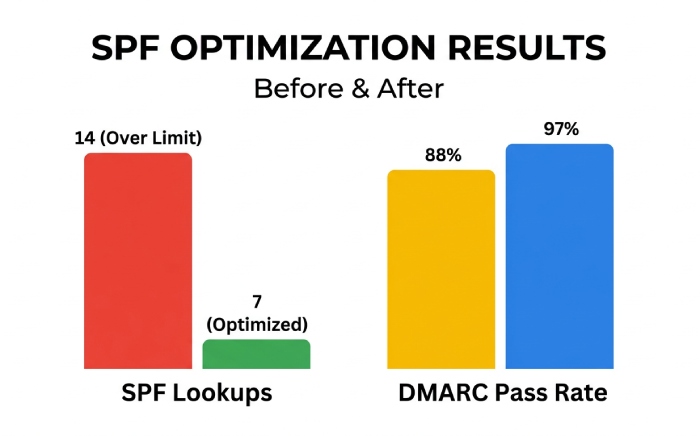
- Before: 12 includes across 8 vendors → 14 counted lookups; intermittent Gmail PermErrors.
- Action: AutoSPF proposed:
- Redirect to _spf.example.net
- Partial flatten for M365 + Marketo (refresh every 24h)
- Consolidate Google + SendGrid as direct includes
- After: 7 counted lookups; DMARC pass rate improved from 88% to 97% within two weeks.
Monitoring and Alerting to Catch Threshold Drift
Signals to Track
- Synthetic SPF expansions hourly with counted lookups and void lookup counts.
- MTA telemetry: SPF result codes by sender IP/CIDR.
- DMARC aggregate (RUA) parsing: volume of SPF fails by source ASN and disposition. AutoSPF ingests DMARC RUA, correlates with expansion snapshots, and alerts when lookups 8 or void lookups 1.
Alert Policies
- Early warning at 8/10 lookups.
- Critical at 10 or >2 void lookups.
- Vendor-change detection: diff upstream SPF TXT; notify on IP churn beyond threshold. AutoSPF provides webhook/Slack/Email alerts with remediation one-click playbooks.
Flattening Services and Scripts”How They Work and When to Use
Mechanics
- Resolve all includes and mechanisms now; replace with ip4/ip6 lists.
- Optional CIDR coalescing to reduce length.
- Scheduled refresh aligns with upstream TTL.
Trade-offs
- Pros: 0“2 counted lookups; faster evaluation; resilient to upstream outages.
- Cons: IP bloat, DNS length limits, staleness risk if refresh fails, loss of vendor agility. AutoSPF mitigates cons with:
- Delta refresh (only change when upstream changes materially)
- Length guardrails (auto-split to subrecords)
- Rollback if flattening fails to validate against test senders
When to Choose Flattening
- You consistently exceed 10 lookups and cant remove vendors.
- Vendors with stable IPs and generous TTLs.
- You need insulation from third-party DNS outages. AutoSPF recommends flattening per vendor based on observed churn rate. A managed SPF flattening service keeps that record compact and automatically refreshed as upstream vendors change.
Real-World Resolver Behavior and Its Impact
Caching, CNAME Chasing, and Rate Limits
- Recursive resolvers may coalesce A/AAAA; still, total DNS traffic can be high during bursts.
- CNAME chains under mx targets add latency (though SPF-count stays 1 for mx).
- Public resolvers (8.8.8.8/1.1.1.1) impose query limits; noisy SPF can contribute to throttling. AutoSPF simulates expansions via multiple resolvers to estimate worst-case latency and throttling risk.
Accounting for Void and Timeout Behavior
- Some receivers treat timeouts more harshly than NXDOMAIN.
- Two consecutive void lookups can trigger PermError at high-volume receivers. AutoSPFs risk score factors resolver heterogeneity to prioritize the most impactful reductions.
Step-by-Step Remediation and Testing Plan
The Playbook
- Inventory senders and as-built SPF
- Gather all domains, subdomains, and envelope-froms; export the current SPF and includes.
- AutoSPF baseline scan maps lookup counts and hot spots.
- Simulate and plan changes
- Test hypothetical includes/flattening in a sandbox zone.
- AutoSPF shows new counts, chain diffs, and reachability for known sender IPs.
- Stage via subdomain
- Create _spf.example.net; use redirect= to centralize.
- Update selective senders to test domain alignment.
- Validate with live traffic
- Monitor SPF/DMARC outcomes; ensure no legitimate sender breaks.
- AutoSPF alerts on anomalies and suggests rollbacks.
- Roll out gradually
- Migrate remaining domains; deprecate old includes.
- Set ongoing guardrails
- AutoSPF continuous monitoring: TTL-aligned refresh and vendor-change alerts.
Verification Techniques
- Known-sender tests: send from each platform; confirm SPF=Pass at major receivers.
- DMARC aggregate deltas: look for pass rate improvement within 48“72 hours.
- Edge-case IPs: test IPv6 paths explicitly; verify AAAA resolution is reflected in Pass.
AutoSPF compiles a verification report with pre/post metrics and a rollback artifact.
FAQ
Does redirect count toward the 10-lookup limit?
Yes”redirect triggers a DNS lookup of the target SPF and counts as 1; it also replaces further evaluation of the current record. AutoSPF counts redirect and displays it distinctly since it changes control flow.
How do mx and a contribute to lookup counts?
Each mx and a mechanism counts as 1 toward the SPF limit, even though real DNS may perform multiple queries (MX host discovery, A/AAAA per host). AutoSPF reports both the SPF-counted and estimated real DNS queries to help you tune resolver load.
Should I ever use ptr or exists?
Generally, no; ptr is discouraged and slow, and exists can be abused or expensive. If you must, constrain their domains tightly. AutoSPF flags ptr/exists and proposes safer equivalents or flattening.
Are multiple v=spf1 TXT records allowed?
No”publish exactly one SPF record per hostname. AutoSPF detects duplicates and generates a single canonical record.
Will flattening break vendor failover?
It can if vendors rotate IPs frequently. AutoSPFs TTL-aware dynamic flattening and vendor-churn heuristics minimize staleness and warn before risk thresholds are crossed.
Conclusion: Make SPF Lookup Analysis Boring (with AutoSPF)
Analyzing SPF include mechanism chains correctly means recursive, deduplicated expansion; precise counting of DNS-triggering mechanisms; strict loop and void-lookup controls; and actionable attribution of what pushes you over the 10-lookup limit. Using disciplined tooling, applying best practices (redirect centralization, selective flattening, TTL-aligned refresh), and continuously monitoring production signals prevents costly deliverability surprises. AutoSPF operationalizes all of this: it parses and simulates your SPF exactly as receivers do, identifies the offending includes, recommends the smallest safe change, automates partial or dynamic flattening with TTL intelligence, and watches your environment so you never drift back over the threshold.
General Manager
Founder and General Manager of DuoCircle. Product strategy and commercial lead for AutoSPF's 2,000+ customer base.
LinkedIn Profile →