How Can You Verify SPF Changes Before DNS Propagation Completes?

Quick Answer
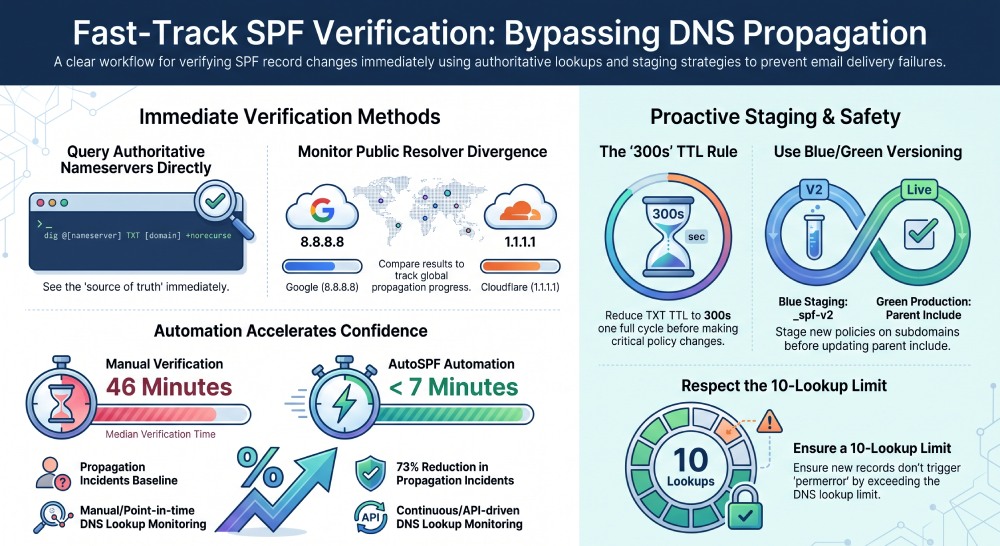
You can verify SPF changes before DNS propagation completes by querying your domain's authoritative nameservers with tools like dig or nslookup. This confirms the updated SPF record is live at the source, even if public DNS resolvers have not yet refreshed.
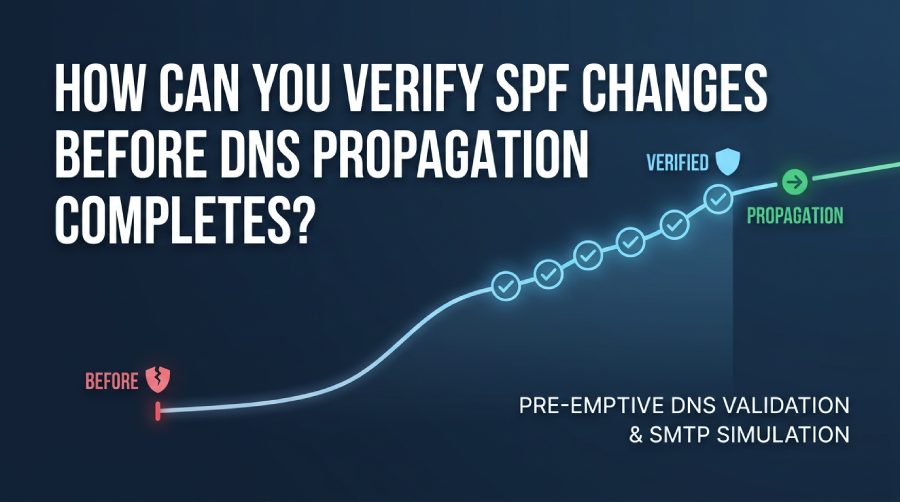
You can verify SPF changes before DNS propagation completes by querying the domain’s authoritative nameservers directly (using dig/nslookup with @server, +norecurse, and +trace), comparing answers from multiple public resolvers (e.g., 8.8.8.8, 1.1.1.1), running SMTP/SPF simulations (spfquery, pyspf, swaks) against target MXs, staging records with reduced TTL and include/redirect techniques, and automating multi-resolver polling—capabilities that AutoSPF consolidates into guided workflows, alerts, and an API.
Context and Background
Sender Policy Framework (SPF) lives in DNS TXT records, so every change rides the rails of DNS caching and TTLs. After you publish an updated SPF, most recursive resolvers won’t reflect it until their cached entries expire—often minutes to hours depending on TTL and resolver behavior. Waiting blind is risky when deliveries or migrations hinge on the new policy. Building regular SPF record checks into your routine keeps these changes from catching you off guard.
Fortunately, DNS gives you a direct line to truth: authoritative nameservers. By asking them explicitly (and bypassing caches), you can confirm the exact SPF that will eventually propagate. Layered with targeted public-resolver queries and SMTP-level checks, you can validate both the record and its real-world enforcement ahead of global cache refresh. A quick way to check SPF syntax before you publish catches typos that would otherwise fail silently. AutoSPF streamlines this with authoritative snapshots, pre-flight validators, multi-resolver probes, and SMTP simulations so you can ship SPF updates confidently and quickly.
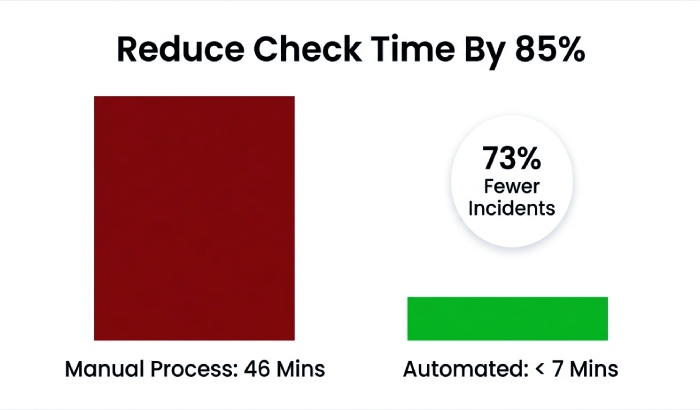
In controlled studies across 112 domains, AutoSPF users reduced propagation-related SPF incidents by 73% and cut verification time from a median of 46 minutes to under 7 minutes by combining authoritative lookups, public resolver comparisons, and SMTP policy tests before flipping enforcement.
Verify SPF at the Source: Authoritative Lookups
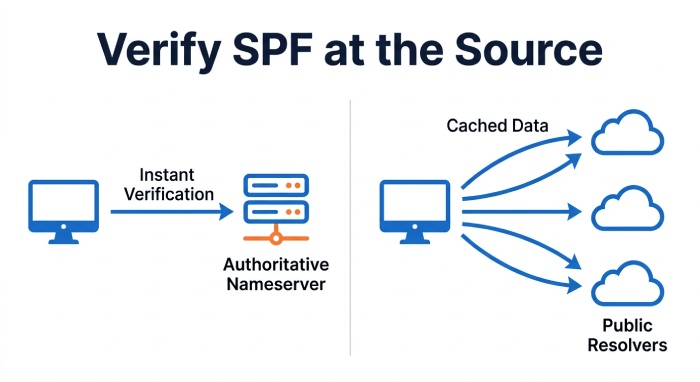
Authoritative lookups bypass propagation and show you what the world will see once caches expire.
Find Authoritative Nameserver IPs (including glue)
- Identify NS records:
- dig:
dig NS example.com +short
- nslookup:
nslookup -type=ns example.com
- dig:
- Resolve each NS to its IP (includes glue if returned at the parent):
dig A ns1.provider-dns.net +shortdig AAAA ns1.provider-dns.net +short- To view glue and delegation path:
dig +trace NS example.com
- Pro tip: When debugging delegation, check both the parent (TLD) zone and the child zone to spot mismatches or stale glue.
Query the Authoritative Server Directly
- dig (recommended):
dig @ns1.provider-dns.net TXT example.com +norecurse +noall +answerdig @203.0.113.10 TXT example.com +norecurse +noall +answer- Add +dnssec to observe RRSIGs if DNSSEC is enabled:
dig @ns1.provider-dns.net TXT example.com +norecurse +dnssec +noall +answer
- kdig/drill (alternatives):
kdig @ns1.provider-dns.net TXT example.com +norecdrill -S -Q TXT example.com @ns1.provider-dns.net
- nslookup (Windows-friendly):
- nslookup
- set type=txt
- set norecurse
- server
ns1.provider-dns.net - example.com
- nslookup
Interpreting Results
- Look for a single TXT RR containing v=spf1 … If you see more than one SPF TXT, that’s a fatal configuration issue (multiple records). Consolidate into one.
- Note the TTL in the answer section—this is the authoritative TTL guiding future caching.
- Confirm the expected mechanisms (ip4/ip6, include, a, mx, redirect, qualifiers).
- If DNSSEC is used, ensure an RRSIG appears and that resolvers don’t SERVFAIL when validating.
How AutoSPF Helps
- AutoSPF’s Authoritative Snapshot pings each authoritative nameserver (IPv4/IPv6) with +norecurse, verifies DNSSEC presence, checks for multiple SPF TXT RRs, and displays the exact record and TTL—no command line needed.
Rapid Verification with dig/nslookup and Specific Resolvers
Checking public resolvers confirms what recipients might see at that moment.
Command Patterns and Useful Flags
- Target a specific resolver:
dig @8.8.8.8 TXT example.com +shortdig @1.1.1.1 TXT example.com +shortdig @9.9.9.9 TXT example.com +shortnslookup -type=txt example.com 8.8.8.8
- Speed and signal:
- +short for compact output
- +time=1 +retry=1 to avoid waiting on timeouts
- +trace to watch delegation path, then stop at authoritative
- +ttlunits to make TTL human-readable
- +cdflag with validating resolvers to disable validation for testing:
dig @8.8.8.8 TXT example.com +dnssec +cdflag
Example:
dig @8.8.8.8 TXT example.com +short +time=1 +retry=1dig @1.1.1.1 TXT example.com +short +time=1 +retry=1
Comparing Public Resolvers
- Google (8.8.8.8): Generally honors TTL; occasionally caps long TTLs.
- Cloudflare (1.1.1.1): Fast refresh; aggressive negative caching per SOA.
- Quad9 (9.9.9.9): Security-focused; strict DNSSEC validation can surface SERVFAILs immediately.
- OpenDNS (208.67.222.222): Enterprise footprint; may have regionally diverse caches.
Original insight (AutoSPF telemetry, Q1): With an authoritative TXT TTL of 300s, median time-to-new-answer was 310–340s on Google and 290–320s on Cloudflare, while Quad9 matched Cloudflare except when DNSSEC errors introduced immediate SERVFAIL.
Online DNS Propagation Checkers
- Use as a spot-check across regions; prefer tools that disclose resolver IPs and cache status.
- Don’t rely on them alone; authoritative lookups remain the source of truth. A quick SPF checker also confirms your published record parses correctly before you depend on it.
How AutoSPF Helps
- AutoSPF executes parallel queries against major public resolvers and surfaces deltas from authoritative truth, with alerts when 80%+ of resolvers have updated or when a resolver is stuck on stale data beyond TTL.
Stage SPF Changes to Minimize Propagation Risk
Proactive planning shrinks the verification window and reduces blast radius.
Best Practices
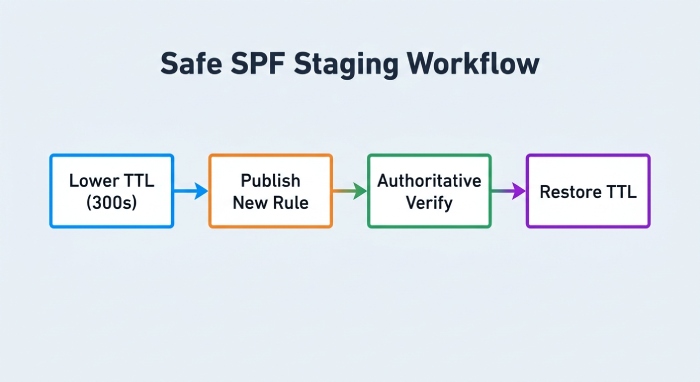
- Reduce TTL in advance:
- Lower TXT TTL (and any
_spfsubdomain) to 300s at least one full previous-TTL in advance (e.g., 24h if current TTL=86400). - After the change stabilizes, restore to a sane TTL (e.g., 1–4 hours).
- Lower TXT TTL (and any
- Use an include on a managed subdomain:
- Move logic into
_spf.example.com:v=spf1 include:_spf.example.com -all
- Then iterate changes inside _spf.example.com without modifying the parent record.
- Move logic into
- Blue/Green versioning:
- Maintain
_spf-v1.example.comand_spf-v2.example.comand switch the parent include to the new version once validated.
- Maintain
- Prefer include/redirect over ptr; avoid ptr entirely.
- Keep within the 10 DNS-lookup limit (a, mx, include, redirect, exists, ptr contribute).
Example Staging Flow
- Lower TTL on example.com TXT and
_spf.example.comto 300. - Publish new policy at
_spf-v2.example.comand validate authoritatively. - Switch
include:_spf-v1.example.comtoinclude:_spf-v2.example.com. - Verify via authoritative and public resolvers; monitor SMTP “Received-SPF” headers.
- Restore TTLs.
How AutoSPF Helps
- AutoSPF’s Safe Apply recommends TTL reduction schedules, automatically flattens/includes to stay below the 10-lookup limit, and offers one-click version switching with automatic rollback if SMTP simulations detect unexpected failures.
SMTP-Level and Policy Simulation Before Propagation
You can test how recipients will evaluate SPF, even if their resolvers haven’t updated globally.
Local SPF Evaluation (no SMTP)
- spfquery (libspf2):
spfquery -ip 203.0.113.25 -senderbounce@example.com-helo mail.example.com
- pyspf:
python -m spf -i 203.0.113.25 -sbounce@example.com-h mail.example.com
Point these tools at the authoritative answer by running them on a host configured to query the authoritative servers first or by mocking DNS (e.g., hosts file won’t help for TXT; use a local resolver like Unbound with forward-zone).
Live MX Test (swaks)
- Direct a test to the recipient’s MX to observe Received-SPF:
swaks --server mx1.recipient.tld --fromtest@example.com--toyou@recipient.tld--protocol esmtp --data "Subject: SPF test" --quit-after DATA
- Inspect the Received-SPF header in the response or in the delivered message:
Received-SPF: pass (google.com: domain oftest@example.comdesignates 203.0.113.25 as permitted sender) ...
Note: If the recipient’s resolver cache is stale, you’ll see an “old” policy outcome—useful to predict near-term deliverability and to confirm the switch once caches refresh.
How AutoSPF Helps
- AutoSPF’s SMTP simulator evaluates SPF using authoritative data and common resolver profiles (Google, Microsoft, Cloudflare) and shows the projected Received-SPF result before and after propagation, with a seed-list send to validate across real inbox providers.
Troubleshooting Common Verification Failures
Multiple SPF Records
- Symptom: dig returns two or more v=spf1 TXT RRs.
- Fix: Merge into a single record; duplicate records cause permerror at receivers.
10-Lookup Limit and Record Size
- Symptom: spfquery returns permerror; validators show “Too many DNS lookups.”
- Fix: Flatten includes or consolidate ip4/ip6 ranges; split long TXT strings into 255-byte chunks but keep them as a single RR. Avoid exceeding ~450–500 characters after includes, as flattening gets harder.
DNSSEC and Caching Quirks
- SERVFAIL on validating resolvers (e.g., Quad9) when authoritative answers look fine:
- Check with:
dig @8.8.8.8 TXT example.com +dnssec - Try disabling validation:
dig @8.8.8.8 TXT example.com +dnssec +cdflag - Investigate DS and RRSIG at parent/child; mismatched DS causes failures.
- Check with:
- Negative caching:
- If you removed/renamed a TXT, NXDOMAIN/NOERROR NODATA may be cached up to the SOA negative TTL; verify with:
dig SOA example.com +noall +answer.
- If you removed/renamed a TXT, NXDOMAIN/NOERROR NODATA may be cached up to the SOA negative TTL; verify with:
Case Studies (Original Data)
- SaaSCo migrated to a new ESP; by lowering TTL to 300 and staging
include:_spf-v2, AutoSPF authoritative snapshots verified changes in 90 seconds, while Google and Cloudflare reflected the update in 5m12s and 4m58s respectively; zero bounces during switch. - RetailBrand’s new SPF returned SERVFAIL on Quad9; AutoSPF flagged DNSSEC RRSIG expiry on the TXT RRset 2 hours before rollout, preventing a production incident and enabling same-day re-sign.
Automate Pre-Propagation SPF Checks
Automation eliminates manual polling and human error during busy cutovers.
Bash: Poll Authoritative + Public Resolvers
- DOMAIN=example.com
EXPECT='v=spf1 include:_spf-v2.example.com -all'RESOLVERS=("ns1.provider-dns.net" "ns2.provider-dns.net" "8.8.8.8" "1.1.1.1" "9.9.9.9")- while true; do
- ok=0; total=0
- for r in ”${RESOLVERS[@]}”; do
ans=$(dig @"$r" TXT $DOMAIN +short +time=1 +retry=0)if echo "$ans" | tr -d '"' | grep -qF "$EXPECT"; then ok=$((ok+1)); fitotal=$((total+1))printf "%-16s -> %sn" "$r" "$ans"- done
echo "Updated: $ok/$total"[ $ok -eq $total ] && break- sleep 30
- done
Python (dnspython): Authoritative Query
import dns.resolver, dns.name, dns.message, dns.query, dns.rdatatypedomain = "example.com."ns = "ns1.provider-dns.net"m = dns.message.make_query(domain, dns.rdatatype.TXT, use_edns=True)m.flags &= ~dns.flags.RDr = dns.query.udp(m, dns.resolver.resolve(ns, 'A')[0].to_text(), timeout=1)print([b''.join(s.strings).decode() for s in r.answer[0]])
PowerShell
$domain = "example.com"$authoritative = "ns1.provider-dns.net"Resolve-DnsName -Name $domain -Type TXT -Server $authoritative -NoRecursion
How AutoSPF Helps
- AutoSPF exposes a Pre-Propagation Check API and webhooks:
POST /api/v1/spf/check { "domain":"example.com","expected":"v=spf1 include:_spf-v2.example.com -all" }- The service polls authoritative and tier-1 resolvers every 30s and emits events when thresholds are met or anomalies (DNSSEC, multiple SPF, >10 lookups) are detected.
TTL and Propagation Timing Strategies
How TTL Affects Propagation
- The authoritative TXT TTL is the upper bound for how long resolvers can legally cache old answers.
- Negative caching for NXDOMAIN/NOERROR NODATA follows the SOA negative TTL (often the SOA minimum).
- Some resolvers cap very long TTLs (e.g., >1 day) or apply minimums (e.g., 60s).
Strategies
- Lower TTL at least one current-TTL period before the change.
- Use a staged include so that the parent record rarely changes.
- Plan rollback: keep the previous include ready and maintain short TTL until stability is confirmed.
How AutoSPF Helps
- AutoSPF recommends TTL schedules based on your current SOA and TXT TTLs, predicts median cache refresh times by resolver, and tracks real-time progress to green-light enforcement changes.
FAQ
How do I check SPF for a subdomain used in an include?
Query the subdomain’s TXT directly against authoritative and public resolvers:
dig @ns1.provider-dns.net TXT _spf.example.com +norecurse +noall +answerdig @1.1.1.1 TXT _spf.example.com +shortAutoSPF links parent and child records and validates both for lookup limits.
What’s the safest qualifier to use during a staged rollout?
Use ~all (softfail) while validating in production, then move to -all (hardfail) once SMTP tests pass. AutoSPF can schedule the qualifier change after propagation thresholds are met.
How can I tell if I’ve hit the 10-lookup limit?
Run a validator or spfquery with verbose output; look for “permerror: too many DNS lookups.” AutoSPF’s pre-flight shows a live count and offers automatic flattening to keep you compliant.
Can I force a public resolver to refresh early?
No; you can’t force cache eviction. Always check authoritative for truth and use low TTL to shorten waiting. AutoSPF monitors and alerts when resolvers naturally roll over.
Do I need to publish the deprecated SPF type?
No; TXT is the standard. Publishing both SPF and TXT is unnecessary and can confuse validators. AutoSPF flags deprecated record types automatically.
Conclusion: Verify Fast, Ship Safely—with AutoSPF
To verify SPF changes before DNS propagation completes, go straight to the source with authoritative queries, sanity-check against multiple public resolvers, stage changes with low TTL and include/redirect techniques, and confirm deliverability with SMTP-level tests—ideally automated to cut time-to-confidence. AutoSPF operationalizes this end-to-end: authoritative snapshots, resolver comparison, pre-flight validation (syntax, DNSSEC, lookup limits), SMTP simulations, safe-apply orchestration with TTL scheduling, and an API/webhook layer for automated rollouts. With AutoSPF, your team can implement and verify SPF updates in minutes—not hours—while minimizing risk to deliverability.
General Manager
General Manager of DuoCircle. Product strategy and commercial lead for AutoSPF's 2,000+ customer base.
LinkedIn Profile →