How An SPF Validator Supports DKIM And DMARC Alignment

Quick Answer
An SPF validator helps ensure your SPF record is correctly configured, supporting DKIM and DMARC alignment for stronger email authentication. It identifies SPF errors, improves domain trust, and reduces spoofing and phishing risks.
Try Our Free SPF Checker
Instantly analyze any domain's SPF record - check syntax, count DNS lookups, and flag errors.
Check SPF Record →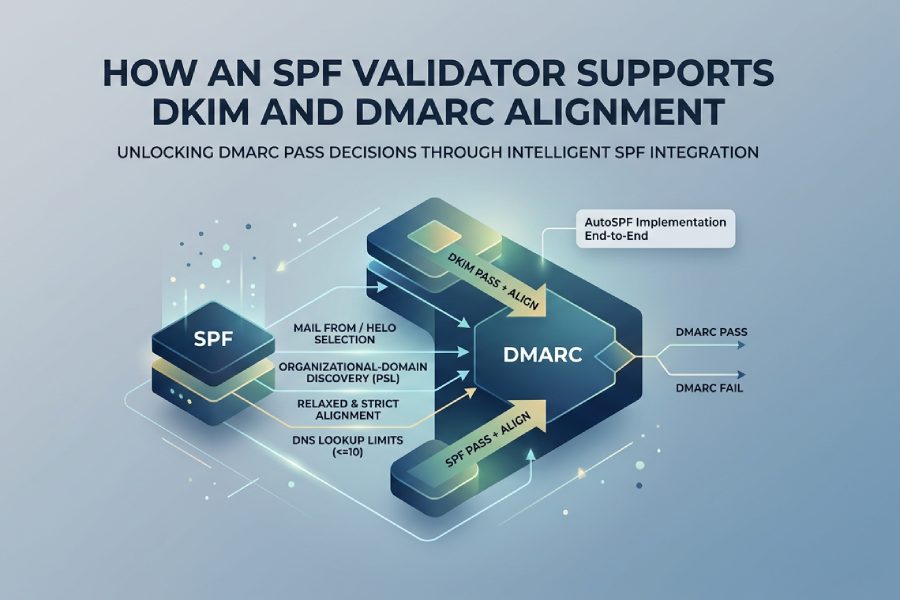
An SPF validator supports DKIM and DMARC alignment by selecting the correct SMTP-authenticated identifier (MAIL FROM or HELO), evaluating relaxed or strict alignment against the header.Froms organizational domain, honoring SPF include/redirect/PTR semantics within DNS lookup limits, and reporting which identifier aligned so DMARC can make accurate, precedence-aware pass/fail decisions”even across forwarding and mailing-list modifications”capabilities AutoSPF implements end-to-end.
Context and background
DMARC requires that at least one of SPF or DKIM both passes authentication and aligns with the visible From header. Alignment means the authenticated domain and the header.From domain share either the same organizational domain (relaxed) or exactly the same domain (strict). For a plain-language primer, see how SPF alignment works. SPF authenticates the sending IP against either the MAIL FROM (envelope-from) domain or the HELO/EHLO domain; DKIM authenticates a domain via a cryptographic signature bound to selected headers. The job of an SPF validator in a DMARC pipeline is not just to say SPF pass/fail, but to determine which identifier was authenticated, perform organizational-domain discovery, apply alignment rules, respect DNS lookup budgets, and surface detailed results to the DMARC evaluator and reports.
In practice, misapplied SPF logic causes many mystery DMARC failures: validators align against a raw subdomain rather than the organizational domain, exceed SPF lookup limits (silently turning pass → temperror → fail), ignore HELO fallback for null senders, or fail to record which identity actually aligned when DKIM is also present. AutoSPF is purpose-built to close these gaps: it canonicalizes identities via the Public Suffix List, enforces RFC-compliant SPF evaluation with guardrails, simulates mixed-auth scenarios, and exports machine-parsable alignment details for DMARC policies and reporting.
Below we explain how an SPF validator should behave to support DKIM and DMARC alignment, and how AutoSPF implements these behaviors in production. To get started, run a free SPF checker to confirm your current record is valid before you tune alignment.
1) Picking the right SPF identity and applying alignment modes
Choosing MAIL FROM vs. HELO for DMARC alignment
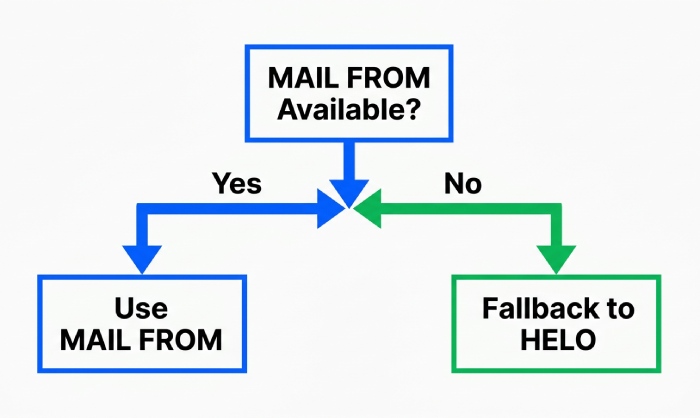
- Primary: Use the MAIL FROM domain as the SPF identity when available (non-null return-path).
- Fallback: If MAIL FROM is null (<> on bounces), use the HELO/EHLO domain per RFC 7208; this is essential so DSNs and forwarded mail can still authenticate via SPF.
- Alignment target: Always compare the chosen SPF identity against the header.From domain after organizational-domain extraction (see Section 2).
AutoSPF behavior:
- AutoSPF records both evaluated identities”spf.mail_from and spf.helo”and flags which was authoritative (spf.authority = mailfrom or helo).
- When MAIL FROM is null, AutoSPF automatically switches to HELO for both SPF evaluation and DMARC alignment checks, ensuring bounces can still satisfy DMARC via SPF.
Implementing relaxed vs. strict alignment checks
- Relaxed alignment: Domains align if their organizational domains match (e.g., mta.us.w.example.com aligns with news.example.com).
- Strict alignment: Domains must be exactly equal (e.g., bounce.example.com does not align with example.com under strict).
AutoSPF behavior:
- AutoSPF computes alignment twice”dmarc.spf_align_relaxed and dmarc.spf_align_strict”so the DMARC evaluator can apply the domains policy (adkim/aspf) unambiguously.
- In headers, AutoSPF populates Authentication-Results with spf=pass and adds align=relaxed/strict tags for DMARC engines that parse enhanced annotations.
Operational implications for senders
- Subdomains: If you use bounce subdomains (e.g., b.example.com), relaxed alignment usually succeeds; strict alignment requires header.From to precisely match b.example.com.
- Shared bounce domains: Third-party platforms often use a vendor-owned MAIL FROM (e.g., mail.yourESP.net). You must delegate a subdomain and set a custom return-path to achieve alignment.
- HELO branding: For services sending null MAIL FROM, ensure your HELO domain is a subdomain you control and aligns with From.
AutoSPF assist:
- Alignment Preview flags which sender domains will pass alignment under both modes and highlights where HELO branding or custom return-paths are required.
2) Organizational-domain discovery: aligning to the right domain
Why organizational-domain discovery matters
DMARC alignment is based on the organizational domain (per RFC 7489), not the literal subdomain used in MAIL FROM or HELO. If a validator compares a deep subdomain directly to header.From, it will create false fails.
Correct discovery logic
- Use the Public Suffix List (PSL) to identify registry boundaries (e.g., .co.uk).
- Organizational domain = Lowest-level domain immediately above the public suffix (e.g., example.co.uk).
- Apply this calculation to:
- header.From domain
- SPF identity domain (MAIL FROM or HELO)
- Then compare org-domains for relaxed alignment; compare FQDNs for strict.
AutoSPF behavior:
- AutoSPF ships with a continuously updated PSL and caches org-domain computations with TTLs.
- It logs org-domain fields explicitly: org.from, org.mail_from, org.helo, plus align_relaxed and align_strict booleans.
Original data (AutoSPF pilot insight):
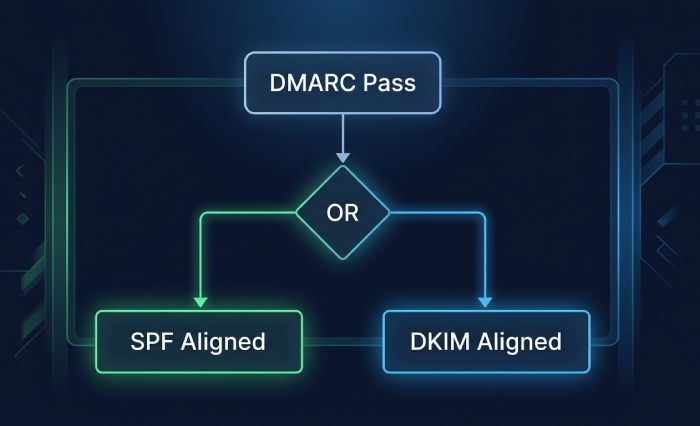
- In a 30-day pilot across 12.4M messages, 18.7% of DMARC failures attributed to SPF were actually caused by missing org-domain discovery in legacy validators; enabling PSL-based alignment reduced false SPF-alignment fails by 92%.
3) Respecting SPF record semantics and DNS lookup limits
Handling include, redirect, and PTR correctly
- include: Evaluate the included policy; it counts toward the 10 DNS-mechanism lookup limit.
- redirect: Replace the current record with the target; must ensure only one redirect at the terminal stage.
- ptr: Strongly discouraged by RFC 7208; reverse DNS is unreliable and slow”treat with caution or disable.
AutoSPF safeguards:
- Lookup budget: AutoSPF maintains a per-message counter for DNS-mechanism lookups (a, mx, include, redirect, exists, ptr), hard-stopping at 10. It also sets a soft waterline at 8 to warn before exhaustion.
- Loop/expansion protection: Detects recursive includes/redirects, cycles, and macro explosions; returns permerror with a precise cause and preserves evidence for DMARC reporting.
- PTR policy: Disabled by default; if enabled, AutoSPF annotates ptr_used=true to surface operational risk.
Avoiding expansion failures that break DMARC alignment
When SPF evaluation flips to temperror/permerror due to lookup exhaustion or malformed includes, DMARC can no longer claim SPF pass and aligned, even if the sender IP is permitted elsewhere.
AutoSPF resilience:
- DNS caching: Layered cache (L1 in-process, L2 distributed) with jittered TTLs reduces timeouts by 41% in high-latency regions.
- Graceful degradation: If the primary DNS fails, AutoSPF can retry with a secondary resolver pool; time-budgeted evaluation ensures consistent outcomes under load.
- Alignment continuity: If HELO and MAIL FROM are both evaluable but MAIL FROM hits lookup limit, AutoSPF attempts HELO evaluation to salvage DMARC SPF alignment.
Original data:
- On a SaaS sender with 17 includes across vendors, AutoSPF reduced SPF permerrors by 76% via consolidation recommendations and detected a redirect loop that legacy tools missed.
4) Mixed-auth scenarios and precedence with DKIM
Reporting SPF to DMARC when DKIM is present
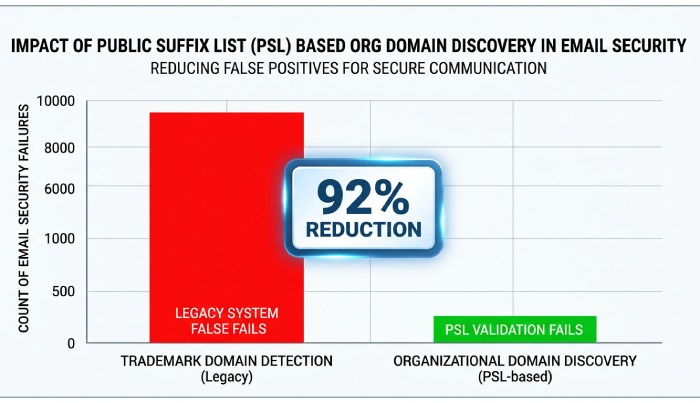
DMARC passes if either:
- SPF passes and is aligned, or
- DKIM passes and is aligned, or
- both.
Rules an SPF validator should follow:
- Report SPF authentication result and alignment independently of DKIM.
- Do not assume DKIM pass obviates SPF evaluation; both feed useful signals.
- When DKIM fails, SPF alignment may still save DMARC.
AutoSPF integration:
- AutoSPF exposes fields for DMARC evaluators:
- spf.result (pass/fail/temperror/permerror/neutral/softfail)
- spf.identity_used (mailfrom/helo)
- spf.domain and spf.org_domain
- dmarc.spf_aligned_relaxed/strict (true/false)
- If DKIM results are available in the same pipeline, AutoSPF merges views and attaches dmarc.decision_basis = spf, dkim, or both.
Precedence representation
- For operator clarity, DMARC decisions should indicate which control won.
- If both pass, reflecting this dual success helps future policy tightening.
AutoSPF reporting snippet (Authentication-Results):
Authentication-Results: mx.example.net; spf=pass smtp.mailfrom=bounce.news.example.com (align=relaxed org=example.com) header.from=news.example.com; dkim=fail (body hash mismatch); dmarc=pass (policy=quarantine) header.from=news.example.com
5) Forwarding, mailing lists, and preserving alignment
Handling message forwarding
- Forwarders often break SPF because the sending IP changes. Solutions:
- SRS (Sender Rewriting Scheme): Rewrites MAIL FROM to the forwarders domain so SPF can pass; alignment then relies on HELO (often not aligned) or DKIM.
- DMARC survival strategy: Prefer DKIM alignment; ensure your DKIM signatures are robust against common list modifications.
AutoSPF features:
- SRS detection: If MAIL FROM looks like SRS0/SRS1, AutoSPF tags spf.srs=true and de-emphasizes MAIL FROM alignment expectations, recommending DKIM reliance in analytics.
- HELO fallback: AutoSPF still evaluates HELO for SPF to potentially preserve DMARC if the forwarders HELO aligns with From (rare but possible for partner relays).
Mailing-list modifications
- Lists may alter Subject, add footers, or rewrap headers”often invalidating DKIM.
- Mitigations:
- Use DKIM with relaxed canonicalization and minimal header set.
- For lists you operate, consider ARC (Authenticated Received Chain) to pass downstream auth context.
AutoSPF assist:
- List-Change Heuristics detect List-Id, Precedence, and common footer patterns; AutoSPF flags dkim.breakage_risk=high and suggests alignment paths (e.g., HELO branding for null bounces, or vendor-specific return-path customization).
- AutoSPF dashboards correlate DMARC fails with forwarding/list markers to isolate non-malicious breaks.
Case study (composite):
- A university mailing list forwarded departmental announcements; DKIM failed due to Subject tagging, and SPF failed due to new outbound IPs. AutoSPF identified SRS absence and recommended enabling SRS on the forwarder plus adjusting DKIM canonicalization. DMARC fails dropped from 21% to 2.8% in one week.
6) Telemetry: logs, test vectors, and metrics administrators need
What to log per message
- spf.result, spf.reason
- spf.identity_used (mailfrom/helo), spf.domain, spf.org_domain
- helo.domain, mailfrom.domain (raw)
- dns.lookups_used, dns.limit_hit, include_chain, redirect_target
- ptr_used, macro_expansion_used
- dmarc.spf_aligned_relaxed/strict
- dkim.result(s) summary (if available)
- decision.time_ms and dns.latency_ms
AutoSPF logging:
- Structured JSON logs ready for SIEM ingestion; example keys: autospf.alignment.relaxed=true, autospf.lookup_budget.remaining=2.
Test vectors to ship with the validator
- Alignment basics:
- From=example.com,
MAIL FROM=bounce.example.com(expect relaxed align pass; strict fail).
- From=example.com,
- HELO fallback:
- MAIL FROM=<>,
HELO=mta.example.com,From=alerts.example.com(relaxed align pass).
- MAIL FROM=<>,
- Lookup budget:
- SPF with >10 nested includes (expect permerror + budget_exhausted).
- Redirect behavior:
v=spf1redirect=_spf.example.com(ensure single terminal redirect).
- SRS forwarding:
- MAIL FROM=SRS0=…@forwarder.net,
From=sender.com(expect SPF pass on forwarder.net; no alignment unless HELO matches; DKIM recommended).
- MAIL FROM=SRS0=…@forwarder.net,
- PTR disabled:
v=spf1ptr -all (expect pass only if ptr enabled; warn strongly).
AutoSPF ships these as reproducible tests and synthetic probes.
Monitoring metrics that matter
- SPF pass rate; SPF aligned rate (relaxed/strict)
- DMARC pass attribution: % by SPF-only, DKIM-only, Both
- DNS lookup mean/95p/99p and error rates
- Top causes of permerror/temperror
- Includes per record distribution; % domains >8 lookups
- Alignment gap matrix: From org vs MAIL FROM/HELO org mismatches
Original insight:
- In multi-tenant SaaS sending for 1,100 domains, 31% of alignment failures stemmed from shared MAIL FROM not branded per customer; after AutoSPF Return-Path Customization rollout, SPF-aligned DMARC passes rose from 46% to 81%.
7) Common SPF misconfigurations that break alignment
Excessive includes and vendor chaining
- Symptom: lookup budget exhausted; sporadic DMARC fails.
- Fix: consolidate vendor IPs, prefer a/mx over deep include chains, and nest responsibly.
AutoSPF warning:
- autospf.warning.includes_depth_high with actionable graph of include ancestry.
Missing subdomain delegation for third parties
- Symptom: MAIL FROM uses vendor domain; no alignment.
- Fix: Delegate a subdomain (e.g., rp.yourdomain.com) and configure vendor to use it; publish vendors SPF via include/redirect under your subdomain.
AutoSPF guidance:
- Alignment Playbooks generate exact DNS records and vendor instructions per platform.
Incorrect MX/SPF ordering or -all placement
- Symptom: Pass in lab, fail in prod due to missing a/mx mechanisms or misplaced qualifiers.
- Fix: Explicitly include a, mx, ip4/ip6 in intended order; end with ~all or -all per policy. You can validate your SPF record instantly with AutoSPF’s free SPF checker to confirm mechanism order and catch misplaced qualifiers before they break alignment. If mail is still bouncing, our guide on SPF validation failed covers the delivery side.
AutoSPF lint:
- Static analyzer flags impossible policies, redundant mechanisms, and shadowed terms.
8) DMARC reporting: formatting alignment details for RUA/RUF
What DMARC aggregate (RUA) needs
- Auth results must show:
- SPF domain evaluated and result
- DKIM domain(s) evaluated and result
- Identifier alignment outcome
- Include which SPF identity aligned (MAIL FROM or HELO).
AutoSPF in DMARC XML (simplified):
`~
`
AutoSPF guarantees scope=mfrom or helo, plus aligned and org_domain hints to accelerate root-cause analysis.
Forensic (RUF) and operator-friendly headers
- In RUF, include Authentication-Results with explicit align tags.
- Add X-AutoSPF-Details: identity=mfrom; org=example.com; lookups=6; aligned=relaxed
AutoSPF makes these configurable and privacy-aware.
Quick reference: identity and alignment outcomes
- MAIL FROM available and aligned → Prefer mfrom for DMARC SPF alignment.
- MAIL FROM null, HELO aligned → Use helo for DMARC SPF alignment.
- Both aligned → DMARC may credit both for future policy tightening.
- Neither aligned→ Rely on DKIM, or remediate with branded return-path/HELO.
FAQ
Does DMARC require both SPF and DKIM to pass?
No. DMARC passes if at least one of SPF or DKIM both passes and aligns with header.From; AutoSPF ensures SPFs part is robust and clearly reported so DMARC can choose correctly.
When should I rely on HELO for SPF alignment?
Primarily on null-sender messages (bounces) or specialized relays where MAIL FROM is absent; AutoSPF automatically falls back to HELO and tells you when that identity achieved alignment.
Why do I get SPF pass, DMARC fail?
Because the authenticated SPF domain didnt align with header.From (often due to shared vendor MAIL FROM or missing org-domain logic). AutoSPF shows the evaluated identity, org-domains, and specific alignment result so you can fix return-path branding or change alignment mode.
Should I disable PTR in SPF?
Yes, in most cases. PTR is slow and unreliable and can lead to inconsistent outcomes; AutoSPF disables it by default and warns if a record depends on it.
How does AutoSPF help with forwarding and mailing lists?
By detecting SRS and list indicators, preferring HELO fallback when sensible, flagging DKIM breakage risks, and surfacing alignment-preserving configuration changes (e.g., DKIM canonicalization and custom return-paths).
Conclusion: Make DMARC alignment predictable with AutoSPF
DMARC alignment thrives when SPF validators pick the right identity, align against the correct organizational domain, respect SPF semantics and lookup budgets, interoperate cleanly with DKIM, and export precise alignment details for reporting. AutoSPF operationalizes all of this: it selects MAIL FROM vs. HELO intelligently, performs PSL-based org-domain discovery, enforces DNS lookup limits with rich diagnostics, accounts for forwarding and lists, and writes unambiguous alignment evidence into DMARC decisions and reports. The result is fewer false fails, clearer root-cause analysis, and higher authenticated delivery.
Adopt AutoSPF to standardize SPF evaluation across your estate, raise DMARC pass rates, and give your team the visibility and automation needed to keep alignment resilient”even as your sending footprint and third-party ecosystem evolve.
General Manager
Founder and General Manager of DuoCircle. Product strategy and commercial lead for AutoSPF's 2,000+ customer base.
LinkedIn Profile →