Honey Trap Scams Explained: How Social Engineering Targets Email Users

Quick Answer
A honey trap scam uses fake relationships and emotional manipulation to steal money, sensitive information, or email access. Learn how to identify warning signs, avoid phishing threats, and protect personal and business accounts with SPF, DKIM, and DMARC.
The Modern Honeytrap Threat Landscape
A honeytrap is a social engineering scheme that uses attraction, intimacy, or emotional dependency to manipulate a person into disclosing secrets, sending money, opening malicious links, or compromising an organization. A honey trap may begin on dating sites, social media, messaging apps, or online dating platforms, but it often moves into email because email feels formal, private, and useful for sharing documents, photos, invoices, travel plans, or “identity verification” materials.
Unlike a basic email scam, a honeytrap scam is relationship-led. The scammer builds a romantic relationship, suggests a sexual relationship, or invents a false relationship to create trust before exploiting the target. In corporate environments, honey trapping may be used for monetary gain, espionage, political purpose, or workplace intrusion.
Email users can reduce honey trap scam risks by implementing SPF, DKIM, and DMARC authentication alongside cybersecurity best practices to detect phishing attempts, prevent email spoofing, and protect sensitive information.
What Is a Honey Trap Scam? Definition, Origins, and How It Differs From Typical Phishing
A honey trap is a deceptive tactic in which charm, seduction, or emotional intimacy becomes the lure. The victim is encouraged to believe they are entering a genuine interpersonal relationship, romantic relationship, or sexual relationship. Once trust is established, the fraudster may request money, sensitive information, login credentials, communication records, or confidential business files.
A typical phishing campaign often relies on urgency: “reset your password,” “pay this invoice,” or “verify your account.” A honeytrap scam is slower and more personal. The trap is not only the malicious link; it is the relationship itself.
How It Differs From Dating Scams and Basic Phishing
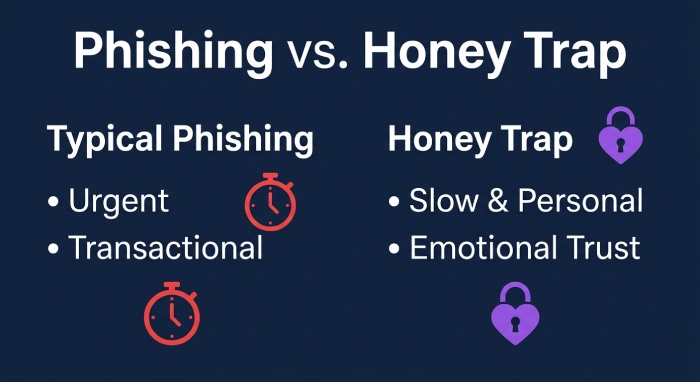 A dating scam typically focuses on building a romantic relationship to obtain money or financial information. A honeytrap scam can involve similar tactics but may also target workplace credentials, confidential information, account access, or sensitive communications. When these scams move to email, attackers may use personal conversations and emotional trust to persuade victims to open malicious links, share sensitive files, or reveal login information.
A honeytrap can also blend with cybercrime: the attacker uses dating sites or online dating apps to build trust, then sends a “photo,” “contract,” or “travel document” by email that contains phishing links or malware.
How Honey Trap Social Engineering Works: Emotional Manipulation, Fake Personas, and Trust-Building
Honey trapping relies on social engineering techniques that exploit trust, emotional attachment, curiosity, or a desire for connection. The attacker creates a convincing persona and adapts their communication to the target’s interests, circumstances, or publicly available information. Over time, this manufactured trust can be used to encourage the victim to share sensitive information, open suspicious links, transfer money, or provide access to accounts or systems.
The Fake Persona Playbook
A honeytrap profile may appear on dating sites, social media, professional networks, or messaging platforms. The person may claim to be a model, entrepreneur, journalist, military officer, crypto investor, aid worker, or private investigator on an assignment. They use attractive photos, shared interests, and intense messaging to accelerate intimacy.
The famous Robin Sage experiment showed how a convincing online persona could connect with security professionals and gather information. In honey trapping, the same principle applies: credibility is manufactured through repetition, familiarity, and selective disclosure.
From Charm to Control
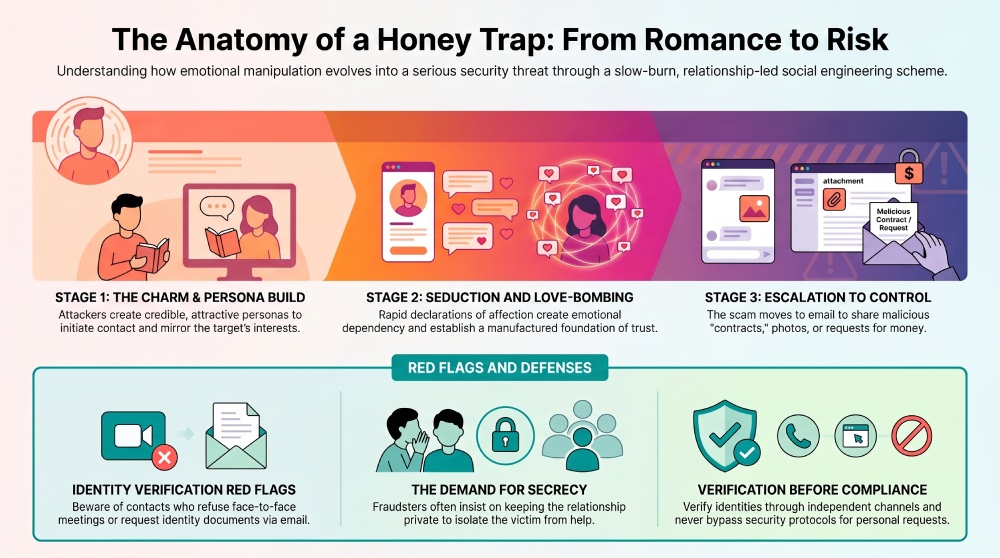
The early stage is charm. The next stage is seduction. The final stage is control. The attacker may push for a romantic relationship, then suggest a sexual relationship, then request secrecy. Eventually, they may pressurize individuals to cooperate by threatening exposure.
- Love-Bombing: The scammer sends constant compliments, quick declarations of affection, and promises of long-term relationships. Online dating conversations may become emotionally intense within days.
- Secrecy Requests: The fraudster may ask the target to keep the romantic relationship private because of family, work, immigration, or cultural issues.
- Email Escalation: The attacker moves from messaging apps to email to exchange files, “contracts,” travel receipts, identity verification forms, or incriminating photos.
Why Email Users Are Targeted: Common Attack Scenarios, Warning Signs, and Red Flags
Email can become an important part of honeytrap scams because it provides a convenient channel for sharing links, attachments, documents, and sensitive information. Attackers know that one compromised inbox can reveal travel plans, client names, invoices, passwords, and communication records.
Common Attack Scenarios
A honeytrap scam may begin with online dating and end with corporate compromise. For example, the attacker meets the target on dating sites, moves to private email, sends a malicious attachment, and later asks for access to workplace documents. In another scenario, a person in a sexual relationship is threatened with blackmail after sharing intimate content.
Attackers may also impersonate trusted professionals or organizations to make their requests appear legitimate. They may claim to be investigators, lawyers, recruiters, financial professionals, or company representatives and then use email to request sensitive information, payments, credentials, or access to files. Verify these claims through an independent and trusted channel before responding.
Warning Signs Email Users Should Notice
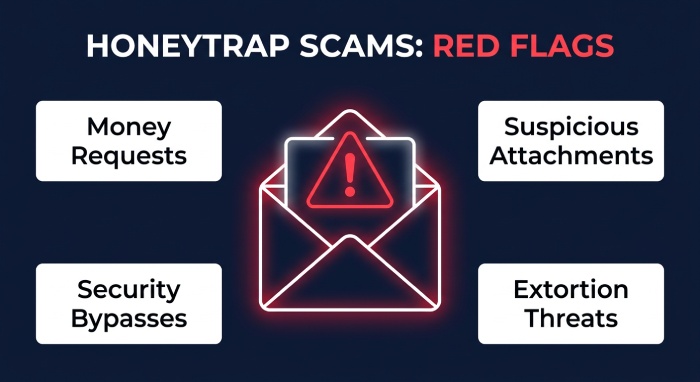
Red flags include:
- A new contact quickly wants a face-to-face interaction but repeatedly cancels.
- The person asks for identity verification documents outside a trusted platform.
- They request money for travel, medical bills, legal problems, cryptocurrency payments, or other emergencies.
- They send attachments containing “private photos” or “proof.”
- They ask you to bypass security measures, disable two-factor authentication, or change privacy settings.
- They threaten extortion if you do not cooperate.
The term “honey trap” is often used to describe scams in which attackers create a false romantic or personal relationship to manipulate a target. For email users, the practical risk is straightforward: if a seemingly genuine relationship leads to demands for money, confidential information, account access, secrecy, or other forms of compliance, it may be a social engineering scam that requires caution.
Real-World Consequences: Data Theft, Financial Fraud, Blackmail, and Workplace Security Risks
The consequences of a honeytrap scam can be severe. Personal victims may suffer financial fraud, reputational harm, emotional trauma, and blackmail. Organizations may face credential theft, data loss, regulatory exposure, and espionage.
Personal and Professional Damage
A victim may be manipulated into sending money, sharing explicit images, or forwarding sensitive information. If incriminating photos exist, the attacker may threaten family, employers, or colleagues. This coercion can escalate into extortion, especially when the victim fears exposure of an illicit affair or sexual relationship.
At work, honey trapping can lead to business email compromise, supplier fraud, insider recruitment, or leakage of client data. A honey trap may also target executives, government staff, finance employees, engineers, and security teams.
Espionage and Corporate Targeting
Espionage-driven honey trapping is not limited to government targets. Attackers may target executives, employees, contractors, or other individuals who have access to valuable information, systems, or business relationships. In corporate environments, social engineering can be used to obtain credentials, confidential information, or access to internal systems.
How to Protect Yourself and Your Organization: Verification Habits, Reporting Steps, and Email Security Best Practices
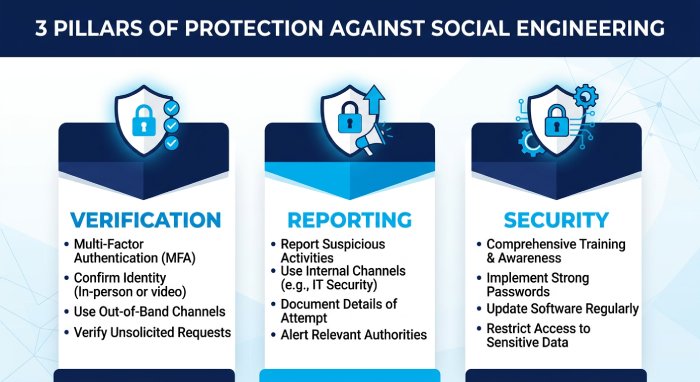 Protection starts with skepticism, verification, and clear reporting. A honeytrap works best when the target feels isolated, embarrassed, or emotionally dependent. Good security culture removes that isolation.
Verification Habits That Reduce Risk
Before trusting a new romantic relationship or sexual relationship formed through dating sites, online dating, or social media, verify identity through multiple channels. Do not send identity documents, workplace files, intimate images, or money to someone you have not reliably verified. Review privacy settings, limit public personal details, and avoid mixing personal romance with workplace systems.
If someone claims to be a private investigator, lawyer, journalist, recruiter, or official, verify their credentials independently. A legitimate private investigator will not demand passwords, threaten exposure, or ask you to install suspicious software.
Reporting and Organizational Controls
If you suspect a honeytrap scam, preserve communication records, do not delete emails, and report the incident to your security team, platform provider, bank, or law enforcement. Organizations should train employees on honeytrap indicators, dating scam overlaps, spear-phishing, and emotional manipulation.
Strong email security practices also matter: enforce two-factor authentication, monitor suspicious forwarding rules, use domain authentication, restrict risky attachments, and teach employees to report unusual messages without shame. The goal is not to police relationships; it is to reduce vulnerabilities that scammers exploit through honey trapping, phishing, and trust-based cybercrime.
General Manager
Founder and General Manager of DuoCircle. Product strategy and commercial lead for AutoSPF's 2,000+ customer base.
LinkedIn Profile →