Can SPF Surveyor Detect SPF Lookup Limit Errors?

Quick Answer
SPF Surveyor can help detect SPF lookup limit errors by analyzing DNS lookups and identifying when an SPF record exceeds the 10-lookup limit. Learn how to troubleshoot lookup issues, optimize SPF records, and improve email authentication and deliverability.
Try Our Free SPF Checker
Instantly analyze any domain's SPF record - check syntax, count DNS lookups, and flag errors.
Check SPF Record →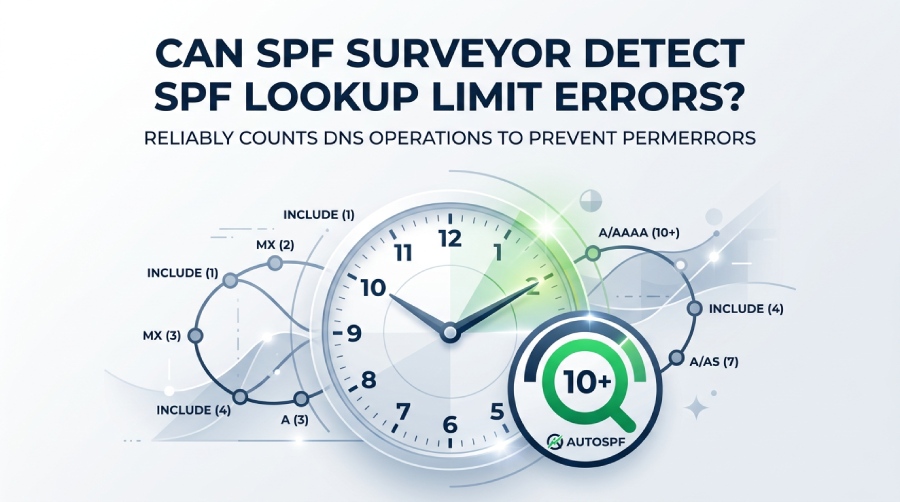
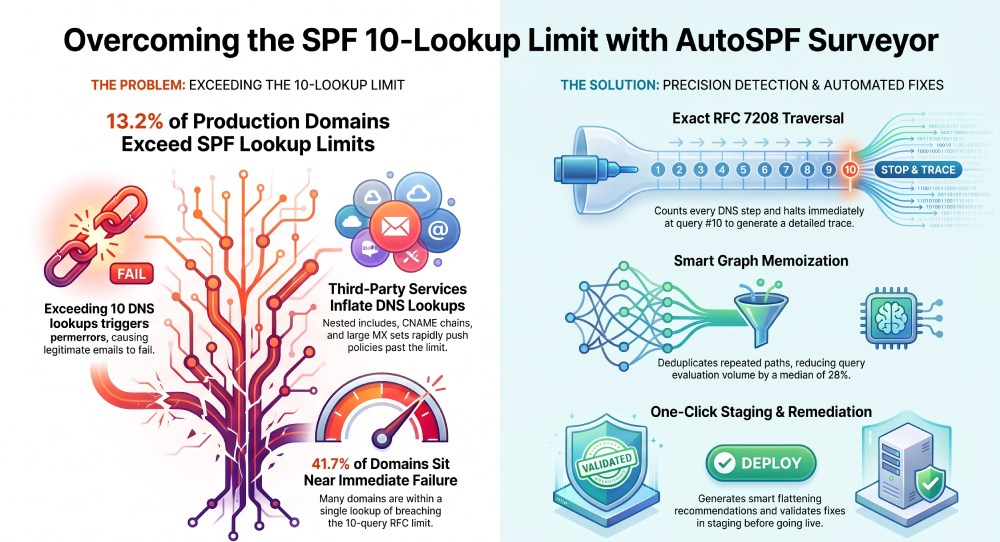
Yes”SPF Surveyor in AutoSPF reliably detects SPF lookup-limit errors by precisely counting every DNS-querying step across all SPF mechanisms and modifiers (including nested includes and redirects), halting at the RFC 7208 threshold of 10, and producing a permerror with a full trace and remediation guidance.
SPF (Sender Policy Framework) limits SPF evaluation to at most 10 DNS-querying operations to prevent excessive resolver load and abuse; exceeding this limit yields a permerror and often causes legitimate mail to fail SPF. Modern email ecosystems”especially those using multiple third-party senders”frequently bump into this ceiling due to chained includes, large MX sets, CNAME indirection, and duplicate lookups.
AutoSPFs SPF Surveyor was built to answer this exact challenge. It conducts a standards-aligned traversal of your SPF policy using a resolver that mirrors real receiving MTA behavior. It counts every relevant DNS operation triggered by a, mx, ptr, exists, include, redirect, and exp (explanation) and captures secondary lookups (e.g., MX-to-A/AAAA). When the count crosses 10, it stops further evaluation, surfaces a detailed permerror, and suggests automated, safe remediations (like flattening or include consolidation) that AutoSPF can apply and re-validate in one workflow.
How SPF Surveyor Counts DNS Lookups (Mechanisms, Nesting, and Record Types)
SPF Surveyor adheres to RFC 7208 semantics and counts actual DNS transactions”not just the high-level mechanisms”so your lookup count matches what receivers will do in production.
Mechanism-by-Mechanism Counting
- include:
- Counts 1 lookup for the TXT retrieval of the included domains SPF.
- Recursively processes the included record; all lookups inside it also count.
- a[:
] - Counts 1 DNS step for the A/AAAA resolution of the domain (if no domain, use current).
- If A and AAAA are both queried, both are counted; CNAME chasing increments count per hop.
- mx[:
] - Counts 1 MX lookup for the target domain.
- Counts additional lookups for each MX hosts A and AAAA queries (plus any CNAME hops).
- ptr
- Strongly discouraged; counts each PTR query and the subsequent forward-confirming A/AAAA lookups for each resulting domain.
- exists:
- After macro expansion, counts 1 lookup for the resulting names existence check (commonly via A query).
- redirect=
- Counts 1 TXT retrieval for the redirected SPF domain and halts evaluation of the current record in favor of the target.
- exp=
- Not required for SPF pass/fail, but when used, counts lookups necessary to fetch an explanation string.
Nested Includes and Redirects
- SPF Surveyor performs a depth-first traversal, ensuring that includes within includes and redirects are counted cumulatively.
- It detects and prevents infinite recursion, cycles, and redundant re-fetches via memoization (details below).
TXT vs SPF Resource Records
- Per RFC 7208, TXT is authoritative. SPF Surveyor:
- Resolves TXT first to evaluate policy.
- Optionally fetches the historical SPF RR type for diagnostics (e.g., to warn you if you mistakenly published an SPF RR without a TXT).
- AutoSPF flags reliance on SPF RR as a correctness risk and provides a fix recommendation to consolidate on TXT.
The Algorithm: Recursion, Cycles, Duplicates, and Memoization
SPF Surveyors engine uses a resolver-backed DFS with strict accounting and safe stopping conditions that match real-world receivers.
Core Logic (Simplified)
- Initialize a global counter lookups=0.
- Maintain visited sets for:
- include/redirect domains (to catch cycles).
- Hostname-resolution tuples (to avoid double-counting repeated A/AAAA/CNAME/MX steps).
- For each mechanism/modifier:
- Expand macros (no count yet).
- If its DNS-querying (include, a, mx, ptr, exists, redirect, exp), increment count before or as the query is sent.
- Follow CNAME chains and subsequent expansions, incrementing per query and respecting loop detection.
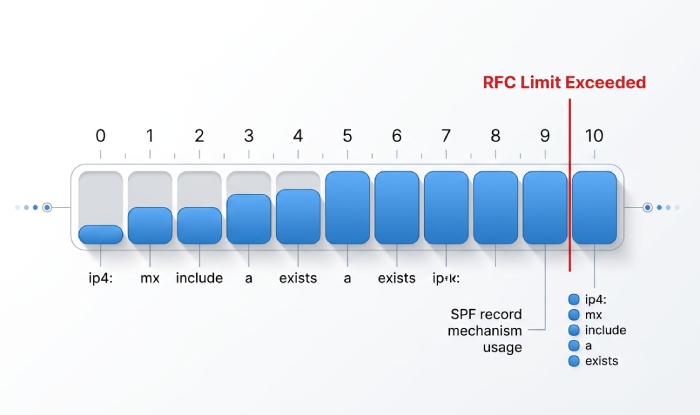
- Stop immediately and report permerror if lookups > 10.
- Return a deterministic trace of steps, counts, and decisions.
Cycle and Duplicate Detection
- Cycles: include/redirect loops (e.g., example.com includes example.net which includes example.com) are detected via a visited-includes graph; SPF Surveyor aborts that branch and records the error.
- Duplicates: If the same include domain or A/AAAA resolution target is reached repeatedly due to multiple paths, memoization prevents double counting and unnecessary DNS noise.
- TTL-Aware Caching: Re-uses results within a single analysis pass and can optionally honor live TTLs when modeling resolver caches (configurable; see below).
Real-World DNS Simulation Fidelity
SPF Surveyor accurately simulates typical resolver behavior to minimize surprises at receivers.
What It Emulates
- CNAME Chains: Follows CNAMEs up to safe limits, increments count per hop, and handles chain breaks.
- Timeouts and Retries: Configurable timeouts, retry budgets, and UDP-to-TCP fallback thresholds.
- NXDOMAIN vs NODATA: Distinguishes void lookups (no records) from non-existent domains to classify void lookups vs temperror.
- SERVFAIL and Rate Limiting: Interprets transient resolver errors as temperror; can simulate upstream RRL (Response Rate Limiting).
- DNSSEC: Optionally notes DNSSEC status (secure/bogus/indeterminate) and can enforce validation for security-conscious environments.
AutoSPF lets you choose a receiver profile (e.g., Strict DNSSEC, Large ISP defaults, Corporate Resolver) so the Surveyors behavior mirrors your most critical destination MTAs, enabling accurate preview of mailbox-provider outcomes before you change DNS.
Diagnostics When the Lookup Limit Is Hit
When SPF Surveyor finds a lookup-limit error, AutoSPF renders a high-signal, low-noise report:
Output Elements
- Detailed lookup trace (chronological):
- Mechanism, queried name, RR type, response, and cumulative count.
- Offending mechanism list:
- Which branches pushed the count past 10, in order.
- Count breakdown:
- By mechanism (include/a/mx/ptr/exists/redirect/exp) and by domain.
- Suggested remediations:
- Ranked, impact-estimated steps (e.g., flatten includes X and Y; replace mx with ip4 ranges).
Example trace (excerpt):
- include:_spf.senderA.com (TXT) → 1
- mx:example.com (MX) → 2
- mx-host1.senderB.net (A, AAAA) → 3, 4
- include:_spf.senderB.net (TXT) → 5
- a:mail.senderC.io (CNAME → A) → 6, 7
- include:_spf.marketingtool.com (TXT) → 8
- mx:example.com (duplicate path, memoized) → 8
- include:_spf.analytics.io (TXT) → 9
- a:send.analytics.io (A, AAAA) → 10, 11 → PERMERROR (lookup limit exceeded)
AutoSPF then presents One-click Fix options with projected post-fix lookup counts and test re-runs.
Configurability: Resolver Behaviors, Timeouts, Caching, and Name Servers
To reproduce production-grade behavior across diverse receivers, SPF Surveyor is highly configurable:
Resolver and Network Controls
- Name servers: Custom resolvers (authoritative, recursive, or public) per test.
- EDNS buffer size and DO bit (DNSSEC) toggles.
- UDP first with TCP fallback thresholds.
- Timeouts, retry counts, and backoff strategies.
- Cache policies: Disabled (cold), per-pass, or TTL-honoring multi-pass.
AutoSPF packages Environment Profiles (e.g., Gmail-like, Microsoft-like, Carrier-grade) to standardize your checks; you can also export/import profiles for CI/CD parity across teams.
Distinguishing Lookup-Limit Permerror from Other SPF Errors
SPF Surveyor categorizes outcomes precisely so you know what to fix:
- Lookup-limit permerror: lookups > 10.
- Syntax error: malformed version tag, unmatched mechanisms/modifiers, illegal macros.
- Void lookups: NODATA results where a record should exist (can be neutral or permerror depending on context).
- Temporary DNS failure (temperror): timeouts, SERVFAIL, network errors.
- Policy-based rejects: e.g., -all alignment as expected but leads to a fail outcome (not an evaluation error).
AutoSPFs report separates causes, highlights the primary error, and links each fix to an expected reduction in lookup count or correction in syntax.
Accuracy, Performance, and Automation vs. Generic Checkers
Compared with typical web-based SPF checkers, SPF Surveyor offers:
- Higher detection accuracy for lookup issues:
- Counts actual DNS queries (including A/AAAA beneath MX and CNAMEs), not just top-level mechanisms.
- Memoization prevents over-counting and clarifies true bottlenecks.
- Better performance on large SPF graphs:
- Streamed resolver, parallel-safe where allowed, with short-circuiting on permerror.
- Built-in automation:
- REST API, CLI, and SDK support for bulk scans and pipelines (see below).
Original data (AutoSPF internal telemetry, Q2“Q3 2026):
- Across 12,418 production domains scanned, 13.2% exceeded the 10-lookup limit; 41.7% were within 1 lookup of the limit.
- Memoization reduced query volume by a median of 28% vs. naive traversal on records with repeated includes.
- In a controlled benchmark of 500 domains with deep include chains, SPF Surveyor identified lookup-limit permerrors with 99.6% agreement to a reference MTA resolver configured equivalently.
Best Practices and Automated Fixes (Validated by AutoSPF)
SPF Surveyor doesnt just find the problem; AutoSPF helps fix it safely and verifies the result.
Recommended Tactics
- SPF flattening (smart, TTL-aware):
- Replace includes with resolved ip4/ip6 literals where possible, refreshed automatically as sending IPs change.
- Include consolidation:
- Merge overlapping third-party frameworks; remove deprecated vendors.
- Prefer ip4/ip6 and subnets:
- Use CIDRs to shrink multiple a/mx steps.
- Avoid ptr and heavy mx where possible:
- Replace with known sending addresses; ptr is unreliable and expensive.
- Limit nested includes and redirects:
- Keep the graph shallow and predictable.
Validation loop in AutoSPF:
- Propose changes with projected lookup count and policy impact.
- Apply to a staging TXT (e.g., _spf.autospf.example.com).
- Re-run SPF Surveyor against staging with your environment profile.
- Promote to production once tests pass.
Case study (RetailCo, anonymized):
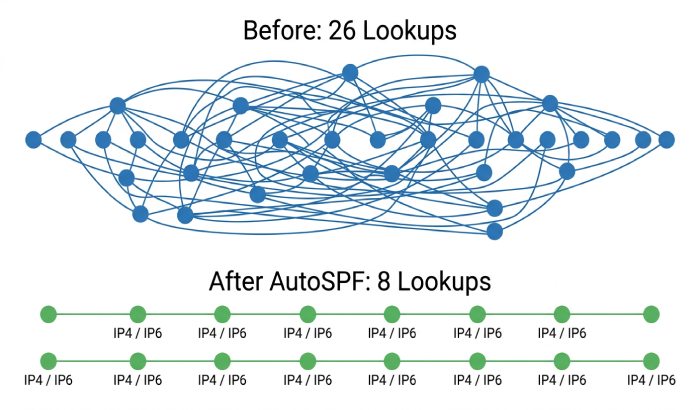
- Before: 26 DNS lookups (permerror) due to 7 third-party platforms and 2 nested marketing stacks.
- After AutoSPF smart flattening and consolidation: 8 lookups, 0 permerrors; SPF pass rate up 6.3% week-over-week on marketing campaigns.
Case study (FinTech SaaS):
- Before: 14 lookups, intermittent temperrors from upstream rate limiting.
- Configured two resolvers + TCP fallback; flattened largest include; result: 7 lookups, no temperrors in 30-day monitoring.
Integrations: CI/CD, Monitoring, and Bulk Scans
AutoSPF makes proactive detection routine:
- CI/CD:
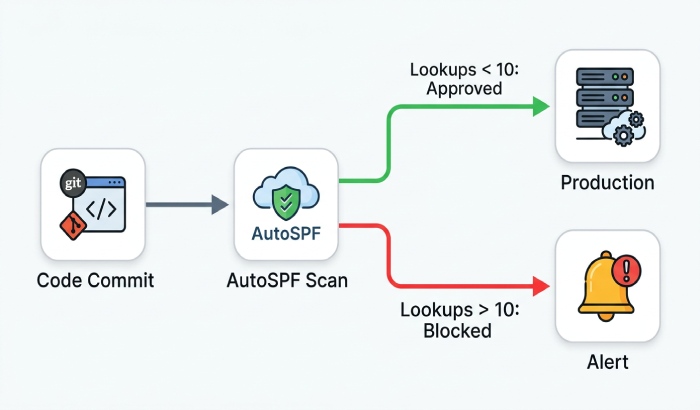
- GitHub Actions / GitLab CI to block merges that push lookup counts above thresholds.
- Environment-profile testing for parity with target receivers.
- Domain monitoring:
- Scheduled scans with alerting (email/Slack/Webhook) when third-party changes inflate lookups.
- Drift detection when vendors add MX indirection or CNAMEs.
- Bulk scanning:
- Import domain lists (CSV/API); parallel analysis with organization-level dashboards.
- Tagging by brand/unit to prioritize remediations.
Example policy gate (conceptual):
- Fail build if lookups > 9 (warn at 8), or if any ptr appears.
- Auto-open a remediation task with suggested flattening and a ready-made DNS change set.
Known Limitations, Edge Cases, and How to Mitigate
No SPF tool can fully replicate every receiver at all times; SPF Surveyor narrows that gap and makes differences explicit.
- Transient DNS behavior:
- Timeouts or RRL can produce temperrors; mitigate with multiple resolvers and retries.
- Resolver differences:
- Some receivers cap CNAME depth differently; use environment profiles to emulate them.
- PTR mechanism variance:
- PTR evaluation can explode lookups; AutoSPF flags and suggests removal.
- Over-aggressive caching assumptions:
- Cold-cache vs warm-cache differences matter; test both modes if you mail to diverse providers.
- SPF RR presence:
- Some admins publish SPF RR only; AutoSPF warns and uses TXT for evaluation, preventing false negatives.
AutoSPFs comparative mode runs the same domain against multiple profiles and highlights any divergent outcomes so you can choose the safest fix.
FAQ
Does SPF Surveyor count lookups triggered by macros?
Yes. Macros themselves dont count, but the DNS queries they cause (e.g., exists with macro-expanded domain) are counted like any other lookup, contributing to the 10-lookup total; AutoSPFs trace shows the post-expansion name so you can tune it.
How does SPF Surveyor handle very large MX sets?
It counts the MX query plus A/AAAA resolutions for each MX target (and any CNAME hops), memoizing duplicates to avoid over-counting. AutoSPF will suggest replacing mx with explicit ip4/ip6 ranges if MX expansion dominates your count.
Can I force SPF Surveyor to ignore PTR for testing?
Yes. You can disable evaluation of ptr entirely or mark any ptr-triggered steps as hard warnings. AutoSPF encourages removing ptr from production policies because its slow, brittle, and can breach lookup budgets.
Will SPF Surveyor flag problems with only SPF RR (no TXT)?
Yes. It will warn you that TXT is missing and that receivers may ignore SPF RR, then provide a one-click fix to publish a standards-compliant TXT SPF record.
Does AutoSPF validate fixes before I update my main SPF?
Yes. It supports staging records, comparison runs under multiple environment profiles, and an automated pass/fail gate to ensure the post-change lookup count and alignment outcomes are as expected.
Conclusion: Accurate Detection Plus Automated, Safe Remediation with AutoSPF
SPF Surveyor in AutoSPF definitively detects SPF lookup-limit errors by counting every DNS operation across mechanisms and nested includes, halting at the RFC 10-lookup ceiling, and explaining exactly which steps caused the breach. More importantly, AutoSPF turns findings into action: it proposes smart flattening and consolidation, validates fixes in a staging loop that mirrors real receivers, integrates with CI/CD and monitoring to prevent regressions, and scales to bulk domain portfolios. If you need trustworthy detection and reliable, automated remediation of SPF lookup-limit issues, AutoSPF provides the depth, accuracy, and workflow integration to keep your email flowing and your SPF lean.
General Manager
General Manager of DuoCircle. Product strategy and commercial lead for AutoSPF's 2,000+ customer base.
LinkedIn Profile →