Anti-Spoofing Solutions: Protecting Your Business from Email Impersonation

Quick Answer
Anti-spoofing solutions help businesses prevent email impersonation attacks by verifying sender identities and blocking fraudulent messages. Technologies like SPF, DKIM, and DMARC strengthen email security, protect brand reputation, and reduce risks of phishing, fraud, and data breaches.
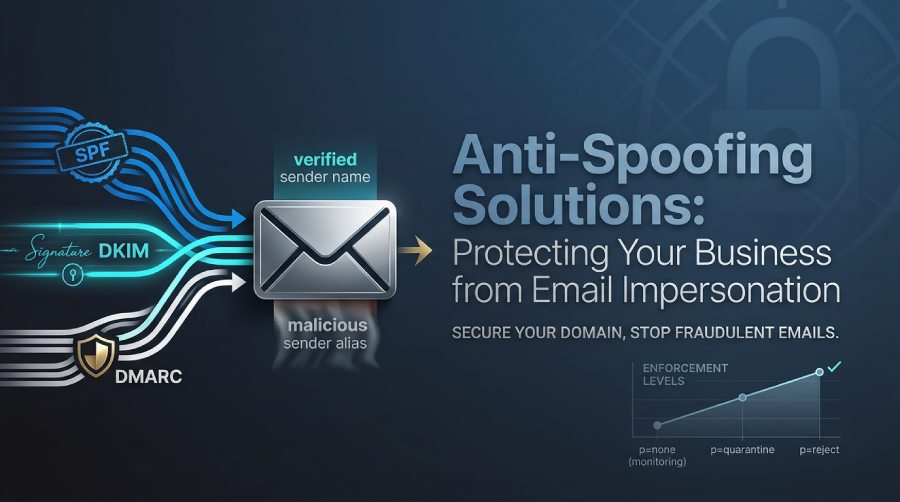
Email remains one of the most heavily targeted communication channels for cybercriminals. Attackers frequently impersonate trusted brands, executives, vendors, and employees to trick recipients into sharing sensitive information, transferring funds, or downloading malicious files. These impersonation attacks, commonly known as email spoofing, continue to grow in sophistication and financial impact.
Organizations of every size are vulnerable to spoofing attacks because email systems were not originally designed with strong sender verification. Without proper authentication and monitoring, malicious actors can send emails that appear to originate from legitimate company domains. As a result, businesses risk reputational damage, financial loss, customer distrust, and security breaches.
Anti-spoofing solutions are designed to stop these attacks by validating sender identities, monitoring domain activity, and preventing unauthorized email use. Modern email security strategies combine authentication protocols, threat intelligence, reporting tools, and enforcement policies to create a more secure communication environment.
What Is Email Spoofing?
Email spoofing occurs when attackers forge the “From” address of an email to make it appear as though the message was sent by a trusted organization or individual. The recipient may believe the message is legitimate because the displayed sender name and domain look familiar.
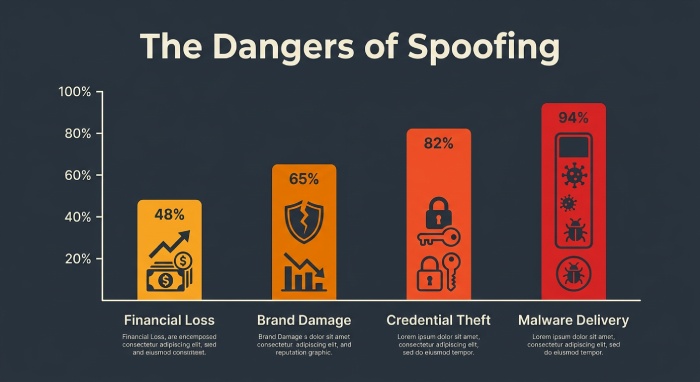 Spoofed emails are commonly used in:
- Phishing attacks
- Business Email Compromise (BEC)
- Credential theft
- Malware delivery
- Financial fraud
- Brand impersonation campaigns
Cybercriminals often imitate executives, payroll departments, financial institutions, or customer service teams to manipulate recipients into taking immediate action.
Why Spoofing Attacks Are Dangerous
Spoofing attacks can affect businesses in several ways beyond simple spam delivery. A successful impersonation attempt may lead to stolen credentials, unauthorized payments, leaked confidential data, or malware infections.
The consequences may include:
- Financial losses
- Regulatory penalties
- Damaged customer trust
- Interrupted operations
- Compromised employee accounts
- Reduced email deliverability
In many cases, organizations do not realize their domain is being abused until customers or partners begin reporting suspicious emails.
How Anti-Spoofing Solutions Work
Anti-spoofing technologies verify whether incoming or outgoing messages are genuinely authorized to use a domain. These systems analyze sender identity, authentication records, DNS configurations, and message integrity before determining whether an email should be delivered, quarantined, or rejected.
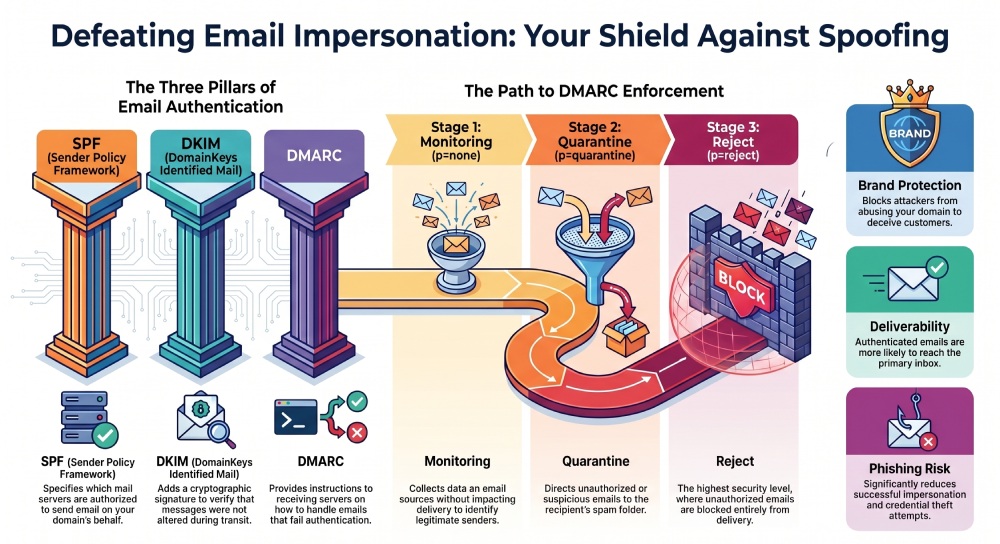
Modern anti-spoofing frameworks typically rely on three core authentication standards:
SPF (Sender Policy Framework)
SPF allows domain owners to specify which mail servers are permitted to send messages on behalf of their domain. Receiving servers compare the sender’s IP address against the authorized list stored in DNS records.
If the sending server is not approved, the email may fail authentication. Validate your own record with a free SPF checker to confirm every legitimate sender is authorized.
DKIM (DomainKeys Identified Mail)
DKIM adds a cryptographic signature to outgoing messages. Receiving mail servers use the public key published in DNS to verify that the message was not altered during transit and was genuinely sent by an authorized source.
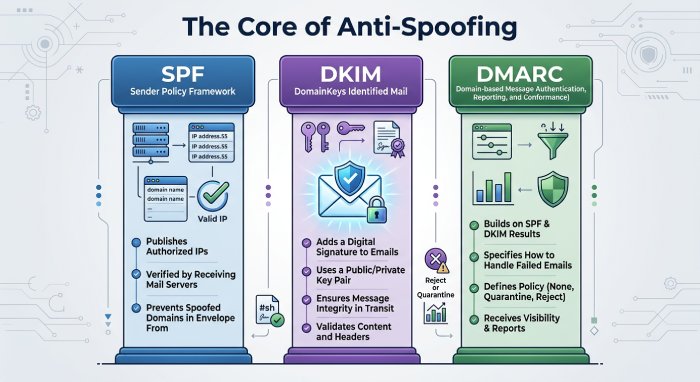 This helps confirm message integrity and sender legitimacy.
DMARC (Domain-based Message Authentication, Reporting, and Conformance)
DMARC builds on SPF and DKIM by telling receiving servers how to handle emails that fail authentication checks. Domain owners can choose monitoring, quarantine, or rejection policies depending on their security goals.
DMARC also provides reporting features that give organizations visibility into unauthorized email activity and authentication failures.
The Importance of DMARC Enforcement
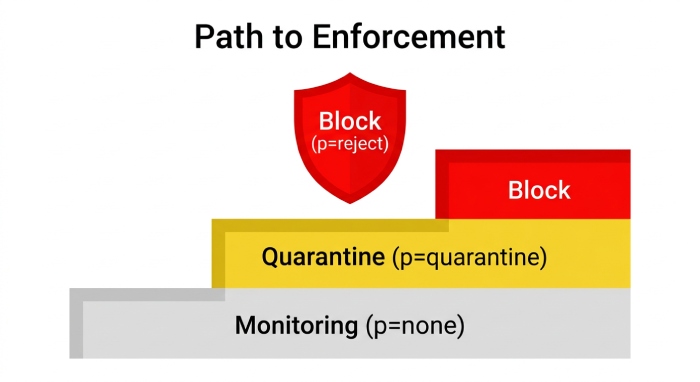
Many organizations publish a DMARC record but never move beyond monitoring mode. While monitoring helps identify email sources and authentication failures, stronger protection requires enforcement policies.
DMARC policies generally progress through three stages:
- p=none — Monitoring only
- p=quarantine — Suspicious emails may be sent to spam
- p=reject — Unauthorized emails are blocked entirely
A reject policy provides the highest level of spoofing protection because fraudulent emails pretending to come from the domain are denied delivery before reaching inboxes.
However, moving to enforcement requires careful configuration to avoid disrupting legitimate email traffic.
Key Components of an Effective Anti-Spoofing Strategy
Organizations should adopt a layered approach to reduce spoofing risks effectively.
Continuous Domain Monitoring
Monitoring tools help identify unauthorized senders, suspicious IP addresses, and authentication failures across all sending sources. This visibility allows organizations to detect abuse quickly and investigate threats before they escalate.
Threat Intelligence
Threat intelligence platforms analyze malicious infrastructure, suspicious sender behavior, and spoofing attempts to improve detection accuracy. Some solutions also provide historical tracking of abusive IPs and attack patterns.
Email Authentication Management
Managing SPF, DKIM, and DMARC manually can become complex, especially for organizations using multiple third-party email services. Automated platforms simplify configuration, validation, monitoring, and policy enforcement.
Reporting and Analytics
Authentication reports help administrators understand who is sending email on behalf of their domain. Advanced dashboards convert raw XML reports into readable charts and actionable insights for faster troubleshooting and threat analysis.
DNS Optimization
Poor DNS management can weaken authentication effectiveness. SPF limitations, incorrect DKIM selectors, or duplicate DMARC records can create security gaps and delivery issues. Proper DNS configuration plays a major role in maintaining strong anti-spoofing defenses.
Common Challenges Organizations Face
Implementing anti-spoofing protections is not always straightforward. Many businesses encounter difficulties such as:
- Complex DNS configurations
- Multiple email vendors
- SPF lookup limitations
- Incomplete DKIM deployment
- Misaligned authentication records
- Lack of reporting visibility
- Fear of disrupting legitimate email
Large enterprises and MSPs managing multiple domains often require centralized tools to simplify administration and policy management. Before flattening at scale, it is worth reviewing common SPF flattening myths.
Benefits of Anti-Spoofing Solutions
Organizations that deploy effective anti-spoofing protections gain several operational and security advantages.
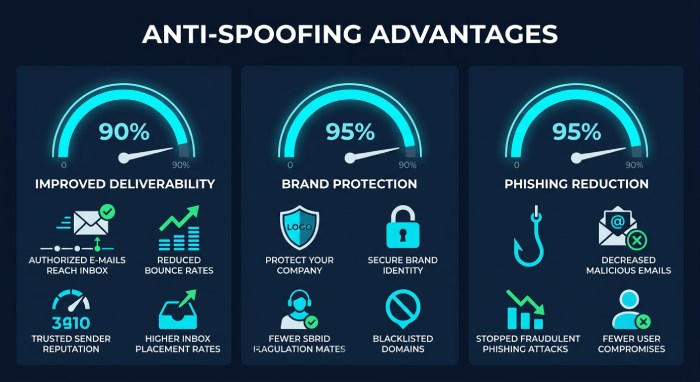
Improved Brand Protection
Blocking unauthorized emails prevents attackers from abusing your domain to deceive customers, vendors, or employees.
Better Email Deliverability
Authenticated email is more likely to reach recipient inboxes instead of spam folders. Strong authentication also improves sender reputation.
Reduced Phishing Risk
By rejecting fraudulent messages, organizations reduce the likelihood of phishing attacks targeting internal users or external customers.
Greater Visibility Into Email Activity
Reporting systems provide valuable insights into legitimate and malicious email traffic associated with the domain.
Enhanced Regulatory Compliance
Many industries now encourage or require stronger email authentication controls to reduce cyber risk and protect sensitive information.
Managed Anti-Spoofing Platforms
Modern anti-spoofing providers offer cloud-based platforms that combine authentication management, monitoring, reporting, threat intelligence, and automated enforcement workflows into a single interface.
These solutions help organizations:
- Simplify DMARC deployment
- Monitor spoofing attempts
- Analyze authentication reports
- Manage multiple domains
- Identify unauthorized senders
- Improve email deliverability
- Streamline DNS configuration
Managed services are especially useful for organizations without dedicated email security specialists.
Best Practices for Preventing Email Spoofing
To strengthen protection against spoofing attacks, organizations should follow several best practices:
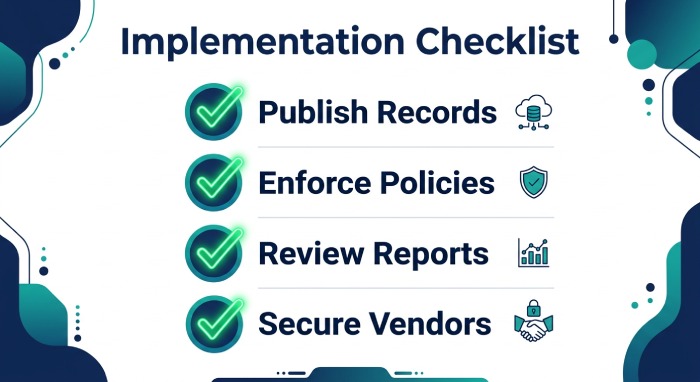
Publish SPF, DKIM, and DMARC Records
Authentication records form the foundation of email security. All legitimate sending services should be properly configured and aligned.
Move Toward DMARC Enforcement
Monitoring alone is not enough to block impersonation attempts. Organizations should gradually transition to quarantine and reject policies after validating legitimate senders.
Review Authentication Reports Regularly
DMARC reports reveal unauthorized activity and configuration problems that may otherwise go unnoticed.
Secure Third-Party Email Services
Marketing platforms, ticketing systems, CRMs, and cloud applications should all be configured correctly to avoid authentication failures.
Monitor Domain Abuse Continuously
Threat monitoring helps identify emerging attacks and suspicious infrastructure targeting the organization’s domain.
Train Employees
User awareness remains essential because attackers often combine spoofing with social engineering techniques.
The Future of Anti-Spoofing Technology
As phishing campaigns become more advanced, anti-spoofing technologies continue evolving to provide stronger visibility, automation, and intelligence-driven detection. Defending against AI phishing threats is a growing priority for these tools.
Future-focused solutions increasingly incorporate:
- AI-powered threat analysis
- Automated policy recommendations
- Real-time attack monitoring
- Advanced reporting dashboards
- Cross-platform integrations
- Centralized domain management
Organizations are also placing greater emphasis on proactive brand protection strategies to reduce impersonation risks before attacks succeed.
Final Thoughts
Email spoofing remains one of the most common and damaging cyber threats facing organizations today. Without proper authentication and monitoring, attackers can exploit trusted domains to launch phishing campaigns, steal information, and damage brand reputation.
Anti-spoofing solutions help organizations verify sender identity, block unauthorized email activity, and gain visibility into malicious behavior targeting their domains. By combining SPF, DKIM, DMARC, threat intelligence, and continuous monitoring, businesses can significantly reduce their exposure to email-based attacks.
A well-planned anti-spoofing strategy not only improves security but also strengthens customer trust, enhances deliverability, and supports long-term operational resilience.
General Manager
Founder and General Manager of DuoCircle. Product strategy and commercial lead for AutoSPF's 2,000+ customer base.
LinkedIn Profile →